Showing posts with label Chiffchaff. Show all posts

Wednesday, 6 April 2016

April update - migration underway!

It has been a busy few days on the island, with settled weather encouraging some good arrivals of migrants - particularly Willow Warblers, Chiffchaffs, Wheatears and Blackcaps, but also some reasonable hirundine passage over land on the clearer days: high counts so far have comprised 30 Sand Martins on the 3rd,  23 Swallows on the 4th and five House Martins on the 2nd. New arrivals since my last post have included Sandwich Tern on the 2nd, a smart Twite hidden amongst the usual Linnet flock on the 3rd, and a passing Glaucous Gull on the 5th. Finch passage has stepped up a gear during the calm spell too, with good counts on the 3rd  comprising 37 Chaffinches, 42 Siskins, 207 Goldfinches, 117 Linnets and seven Lesser Redpolls - some of which we managed to catch at the obs.

The weather has currently taken a turn to the breezy side of things, but it remains bright and sunny with the odd shower, and good numbers of phylloscs are finding shelter in the island's gardens and vegetated areas. We are all hoping that the forecast predication of consistent easterlies is going to materialise at the weekend and into next week, but for now here are some images from the sunny and migrant-filled days of April so far...

Phylloscopus warblers are arriving in earnest now, with Willow Warbler increasingly featuring in daily counts. The ratio of Chiffchaffs:Willow Warblers remains more or less equal at the moment, although this is likely to tip in favour of the latter as we progress through spring. The highest counts for each species have so far been 72 Chiffchaffs on 3rd April and 111 Willow Warblers on 4th April

(as a footnote, and for those interested, these images were taken in our polytunnel, where as many as six phylloscs decided to make use of a bounty of small flies! I have never seen so many inside our polyntunnel, but they were perfectly happy and allowed for some interesting photo opportunities!)

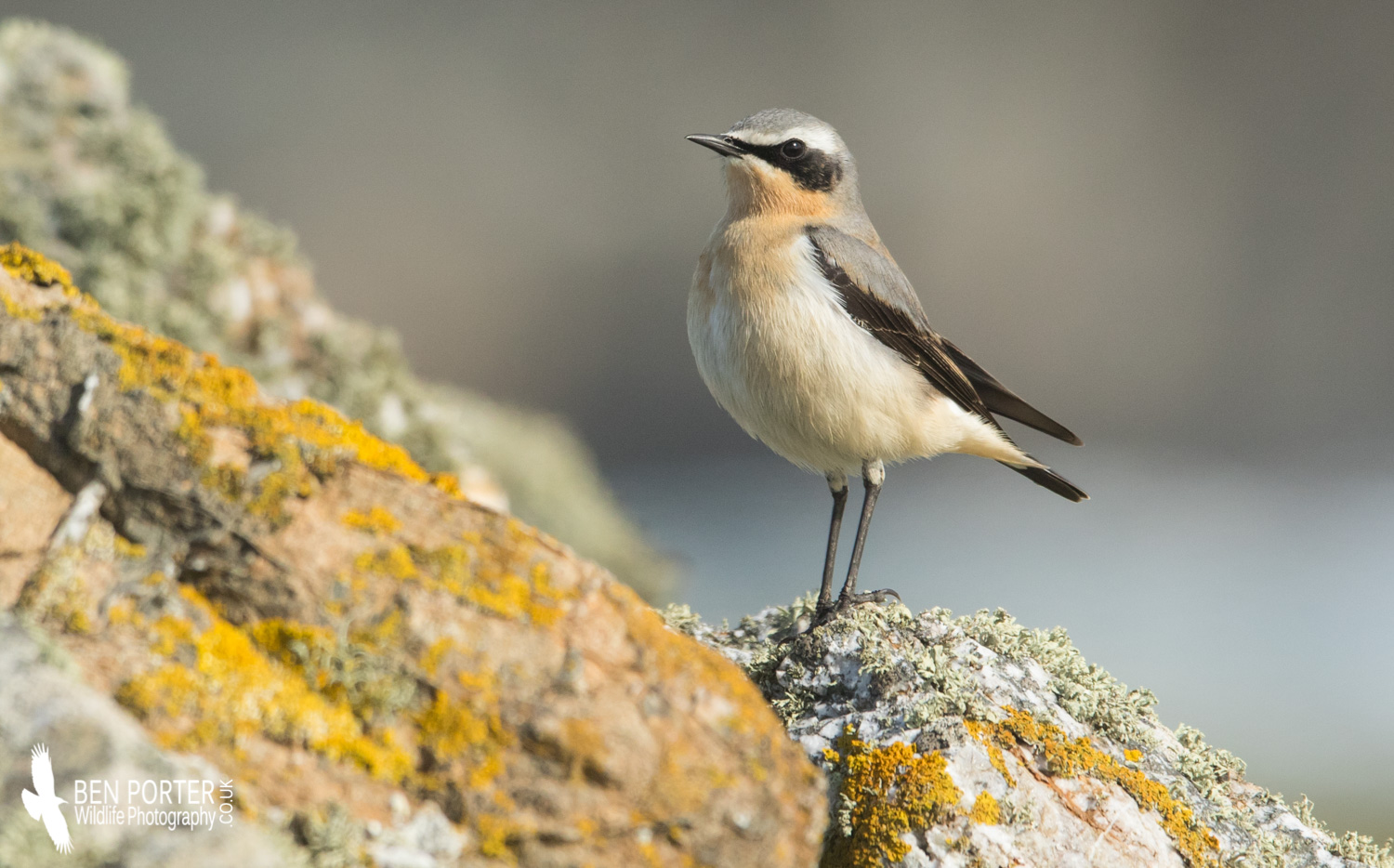
Wheatear numbers continue to rise too - there haven't been any Greenland-race birds as yet, but these have already been recorded further north up the coast at Hilbre. A superb sighting today involved a Darvic-ringed bird on the South End, which turned out to have been ringed on 29/07/2015 on the Calf of Man!

A recent wave of Stonechat arrivals included some superb males, which spent much of the sunny day singing their hearts out and song-flighting. Amongst the impressive vocabulary of the birds were Sandwich Tern, Grey Wagtail and Peregrine Falcon!


Auks continue to return sporadically to the East Side cliffs, although are gradually becoming more established and spending fewer absent days out to sea. I used a slow shutter speed of 1/80th sec to capture the movement of this Guillemot

Blackcap numbers are on the increase, with 35 on the 3rd being the highest count thus far.


Moths have been well-represented over the last few days, particularly due to the current new moon and settled conditions. The highlight so far has been this superb male Oak Beauty in the Ty Capel heath trap, which is only the second record for Bardsey!

Otherwise, the usual fair of Early Greys and Early Thorns, Common Quakers, Red Chestnuts, Hebrew Characters, Mottled Greys and Double-striped Pugs have been finding their way into the traps...
Early Thorn

It was cool to come across a small colony of social bees a few days ago, which seemed to have recently emerged from a handful of small holes in the earth bank. They were Andrena bicolor, which is a relatively widespread species, but one which I have not seen before

this odd-looking Robber Fly (Asilidae) was present nearby, but I have no idea which species it is!


Some of the Chiffchaffs moving through have possessed these curious-looking 'pollen horns' - best seen on birds trapped for ringing. These horns are formed from the build up of pollen and nectar that accumulate on the feathers of the forehead when birds feed on a variety of flowering plants on their way up through the Mediterranean region

we trapped a couple of Meadow Pipits a few days ago - one was an age 5 (first summer bird - top in the image above), whilst the other was age 6 (adult - lower left, with neat tips to the median coverts and small 'tooth' indents at the tip). Note the length of the hind-claw, which is typically longer than 11mm in Meadow Pipits, compared to <9mm in Tree Pipits

We were fortunate enough to have a net full of finches during a ringing session on the 3rd...amongst them were 11 smart Siskins, which provided great practice for ageing these stunning finches. Note the brown, pointy tail feathers of the first summer, compared to the broad, glossy and blunt-tipped remiges of the adult


As an end to this post, I thought I'd post a few images from a rubbish pick-up which we carried out on Saturday. Everyone on the island turned up to help clear away the repulsive build-up of plastic waste which has been blowing in with the wind and tides throughout the winter. We managed to fill FOUR dumpy bags with the stuff - a brilliant effort that really does make the island look a good sight better, and hopefully a little safer for wildlife, as this sad example below illustrates...
The results of the rubbish pick-up

Why we have the need to paying more attention to fishing and plastic waste in our seas - this young female Grey Seal turned up yesterday with this large green mesh around its head. A real shame, and we will see what can be done if it continues to appear on the shore

Friday, 1 April 2016

Back on Bardsey...let Spring begin!

Last week my sister and I made the long trek up from Cornwall to North Wales by train, and managed to catch a weather window on Friday morning to be ferried across a lively Bardsey Sound by Colin back home to Bardsey Island. It was great to get back home before a bought of unsettled weather blew through over the weekend, bringing rain, wind and temperatures more akin to the depths of winter! Nevertheless, conditions have somewhat redeemed themselves in the last few days, bringing the characters of springtime emerging from every corner of the island...

I will endeavour to post more regular updates during my time on Bardsey over easter, as spring migrants arrive and a host of interesting insects emerge. I am hoping to stay on the island until late April at least, with the laxity of third uni term dictating that four exams mid-May are the only pressing needs to return south for!

So anyway, here a few highlights and images from Ynys Enlli over the last week - and what a first few days it has been!

These impressive clouds rolled over during the morning of the 25th, and provided a great opportunity for some landscapes

One of the coolest things waiting for me upon return was this dead Turtle in our compost! A day visitor had come across this unfortunate reptile a few weeks ago, and had given directions via email as to where to find it. After a getting input from a variety of people online, it was revealed that it is in fact a young Green Turtle - only the third ever recorded in Wales!
This species' range extends in a broad belt around the tropics and subtropics, and is classed as endangered by the IUCN due to the large number that get caught up in fishing gear, and also the loss of suitable beaches for nesting.


The main excitement at the moment is focussed on avian fauna, with the first few migrants arriving on the island over the last week. We have already had some of the classic spring migrants like Wheatears, Swallows and Chiffchaffs, but a host of other interesting species have been around too.

Here is a list of the avian migrants that have arrived so far - plenty more to come!
- Chiffchaff: 12th March
- Northern Wheatear: 12th March
- Manx Shearwater: 13th March
- Black Redstart: 14th March
- Blackcap: 23rd March
- House Martin: 25th March
- Sand Martin: 26th March
- Willow Warbler: 26th March
- Swallow: 29th March (first March record since 2012)

Northern Wheatear - most of the birds that have arrived so far have been males (>90%), which is partly because they will try and reach suitable breeding sites to set up their territories before females arrive

Chiffchaffs have been steadily increasing in number, with a count of 42 on the 31st being the highest total so far. Not all of the arrivals will be 'true' afro-tropical migrants, but the presence of 'pollen horns' at the base of the bill is a sure indication of the origin of some - these horns are where the feathers have stuck together due to the accumulation of pollen derived from feeding on the nectar of plants through the Mediterranean region en route

Not a species we usually conceive as being a migrant, but Stonechats also arrive in good numbers from the continent, and bring with them an impressive variety of mimicry in their punctuating songs. I couldn't quite believe it when I heard one producing a Peregrine's call, along with Sandwich Tern and Swallow!  

This utterly amazing female Long-eared Owl was trapped by Steffan in the Heligoland trap on the morning of the 31st, becoming the first to be ringed on the island since 2012! We saw the bird later in the day associating with two Buzzards, before the trio caught a thermal and worked their way up to cloud base within the space of about two minutes - who knows where it is now!
You can check out a map and table detailing recoveries of ringed Long-eared Owls in Europe by following this link to the BTO website...click here

Goldcrest numbers have been increasing when conditions dictate - yesterday, for example (31st), the island was covered in these tiny warblers, amounting to no fewer than 154 individuals! We trapped and ringed 64, and their weights varied from very light indeed (4.7g) to well-fed (5.9g). Most of the trapped birds were 2nd calendar year males, with fiery-red centres to the crest and pointy tail feathers

the island's breeding pairs of Choughs have been flying overhead with beak-fulls of various nesting materials recently. Some have been collecting bits of gorse twigs, whilst others have been gathering large white pompoms of sheep's wool - they look quite comical in flight! Hopefully the island's eight or nine pairs of breeding Choughs will have a good season


The night sky over the last two days has been breathtaking, and so I took the opportunity to try out a few night-scapes...
This image is looking south-west over Bardsey Lighthouse towards southern Ireland (the small patches of light pollution on the horizon), and the constellation of Orion is visible to the right of the South End.

The brilliant thing about being out on such a calm night is hearing the calls of the Manx Shearwaters ringing out overhead. Here is a recording of a couple of birds in their burrow...


And finally, a few insects...

Bumblebees have been appearing all over the island, particularly attracted to the pussy willows and pollen-rich buds of the Willow. Two species have been seen so far, and most sightings have involved large Queens that are seeking out a suitable site to rear a colony. This is Bombus lucorum, or the White-tailed Bumblebee

This smart Hawthorn Shieldbug was amongst the moths in my heath trap on the 29th - I haven't seen this species of shieldbug on the island before, although they are a common species elsewhere, and there is plenty of suitable habitat for them on the island

This fluffy orange caterpillar was wandering about in the grass near the plantation, and is a Buff Ermine caterpillar - it was probably looking for somewhere to pupate ready for its emergence in late Apri/early May. It will take slightly warmer temperatures than at present to encourage more species to emerge!

This curious and miniature Woodlouse is an Ant Woodlouse (Platyarthrus hoffmansegi). Amazingly, they live most of their lives underground and beneath rocks in the nests of various ant species, such as this Black Ant (Lasnius niger). It is thought that the ants tolerate their ghostly presence because they clear the next of debris and faeces. On the island, they can be found around Ty Pellaf and the Limekiln in the banks

Keep up to date with news from the island/my photography at the following sites...

Monday, 23 November 2015

Ringing and Birding Nanjizal - 23rd November

After what has felt like weeks of constant windy and wet weather, it was a pleasant surprise to see a gap open up for Sunday and Monday. This spurred a few of us C permit holders on campus to try and get down to Nanjizal for one last ringing session before Kester brings the nets down for the winter. With the forecast looking good for Monday, I decided to head back to this brilliant ringing site with fellow ringers Ellie Mahew, Louis O'neill and his partner. We headed off early to get down to the valley just after dawn; the conditions were superb, with clear skies, low winds and very chilly temperatures encouraging an excellent movement of migrants. We passed a large flock of c. 5000 Starlings emerging from their roost at Marazion on our way, and arrived on site for one of the first net rounds, after Kester had opened up a while beforehand.

We had a fantastic morning's ringing, trapping a total of 74 new birds, and processing around 20 retraps. It was surprising to find so many Chiffchaffs flitting around the trees and willows, with a total of 30 new birds ringed, and a further 10 retraps! Perhaps the highlights of the morning came in the form of a Water Rail (one of at least four on site), several stunning Firecrests, a Cetti's Warbler, an impressive four Siberian Chiffchaffs, and a good handful of Redwings and Song Thrushes. Commoner species trapped during the morning included Chaffinches, Long-tailed Tits, Goldfinches and Blackbirds. Check out the images below for some more detalils on the ringing session.

In addition to the ringing, it was fantastic to witness the visible migration taking place overhead. The morning's totals were quite impressive by the time we left, in particular due to the movement of Woodpigeons that was taking place. We recorded the following: 1342 Starlings, 1643 Woodpigeons, 27 Siskins, 55 Chaffinches, two Bramblings, two Reed Buntings, 12 Snipe, six Stock Doves, 17 Skylarks, 10 Goldfinches, nine Golden Plovers, 10 Lapwings, 10 Greenfinches and two Mistle Thrushes. A great morning all-in-all; it really was nice to be back down in this amazing site.

A crisp morning at Nanjizal

This cracking Water Rail was one of the highlights of the morning. They are not to be messed with: this seemingly docile and shy creature can be a voracious carnivore, eating anything it can get a hold of


Most of the Firecrests we trapped during the morning were re-traps from previous sessions, but there was one new bird in the mix. This stunning male was aspiring to be a Pacific Royal Flycatcher!!

It was cool to catch a total of four Siberian Chiffchaffs during the morning, all of which were really smart birds that gave a lovely Bullfinch-like 'huuet' call upon release. Here are two of them in the above image, alongside a Common Chiffchaff (far left) 

And again, the tristis on the right and a collybita on the left

One of the Siberian Chiffchaffs trapped and ringed

A comparison of tail shape in Chiffchaffs, for ageing a juvenile and an adult. You can see the browner, tatty and more pointed tail feathers of the juvenile (age 3) on the right, compared to a lovely broad and glossy adult (age 4) on the left

Several Long-tailed Tits found their way into the nets during the morning, although most already sported rings

 One of the seven Redwings ringed during the morning
 An interesting abnormality on the 5th tail feather, with a highly attenuated tip! Very odd

Fault bar with a capital 'F'!! This Robin obviously experienced some stressful or adverse environmental condition during the developmental process when growing the feathers at this point! A look under the upper mandible confirmed this bird as an age 3, due to the extensive yellow colour 

Great to see an adult Great Tit, with bright blue fringing to most of its flight feathers and coverts, compared to the duller tones and contrast in a juvenile's wing

Saturday, 21 March 2015

Spring update

Well, its been an exciting few days on the island: on the night of the 16th, we were treated to an amazing display or aurora, with faint green curtains to the north turning into a spectacular scene once a camera and 30 second exposure were taken to it. Yesterday (the 20th), the awesome solar eclipse took place in clear blue skies between 0830 and 1000 in the morning- it was very cool to watch the whole spectacle unfold with the aid of a white light filter, my Dad's telescope and my own camera and lens. The results of the near-total eclipse are pictured below.

Its not just the meteorological side of things that have been interesting- spring is really warming up now, with moths emerging, migrants arriving, and lambs appearing. The first Sand Martins of the year have flown North over the island (18th+19th), and more and more Wheatears continue to arrive, accompanied on the 18th by some 20 Stonechats. Chiffchaffs are starting to sing, and are also increasing in number, along with Goldcrests. Finches have been on the move in the last day or so, with Goldfinches, Greenfinches, Siskins, Lesser Redpoll, Bullfinch and House Sparrow all recorded. A pair of Puffins have been seen off the North End too, which is quite early for their arrival here. Manx Shearwaters are now on the island too, and can be heard every now and then at night. I have uploaded a small selection of images from the last few days: 

This was pretty flipping awesome!! The Northern Lights from Bardsey, with the Celtic Crosses and 13th century Abbey in the foreground

The Solar eclipse was an awesome spectacle, taking place between 0830 and 1000 on the 20th. Using a white light filter in the clear blue skies, it was great to be able to get images of the sun and look directly at it. Towards the end of the eclipse some cloud rolled in and acted as a natural filter (lower image)

Honey Bees have been out collecting pollen from a variety of sources, including gorse and pussy willows (above)

I have had a small heath trap (moth trap) out in the last few days, and on the calmer nights this attracted a small range of species, including classic earlies like Dotted Border, Early Grey, Mottled Grey, Red Chestnut, Hebrew Characters and some micro moths such as Agonopterix heracliana and Emmelina monodactyla 
Hebrew Character

Early Grey

Dotted Border

Common Buzzard

Chiffchaffs have been moving through in decent numbers, although they have not arrived in true force as yet. Its been great to hear a few singing, and feeding in a classic spring setting of these pussy willows

A selection of Wheatear images taken in the last few days around the coast. It has been interesting to see how virtually all the birds at the moment are males. The first two females have only just arrived today (21st), which is over 10 days since the first males arrived on the island. This is presumably so that males can start singing and displaying on territory before the females arrive

Goldcrests

Raven flying in front of Bardsey Lighthouse