Showing posts with label the cloud forest. Show all posts

Friday, 13 March 2015

Photographic highlights from Bellavista, Ecuador

After arriving back in the UK last Saturday, I now am in the possession internet again, which should allow me to upload quite a few more images from my trip to Ecuador over the next few weeks. I am going to start the instalment with a blog of photographic highlights from my time at Bellavista Lodge. It is going to take a long time to produce a detailed trip report-style blog on my time in Ecuador overall,  and so for now I will focus on particular areas or species. I have uploaded a selection of images for this post, which were all taken around the Bellavista Cloud Forest Reserve area, near in the Tandayapa Valley in Pichincha province, Ecuador. The equipment I used to take all of the bird images was a Canon 7D and Canon 300mm f2.8 USM lens, whilst any macro work was using a Sigma 105mm f2.8. I hope you enjoy...


A Montane Woodcreeper- the other common species of woodcreeper at Bellavista, and a much smaller relative of its monstrous cousin

Two of the lodges most colourful tanagers: the stunning Grass-green Tanager above, and the bright Blue-winged Mountain-tanager below. The latter of these species is said to be the leader of mixed species flocks, and it is certainly true that their high pitched and excited calls are often the first thing that is heard before a flock is encountered. It is thought that other species such as warblers, furnariids, and woodcreepers follow the tanagers because of the increased protection they offer from predators. Tanagers such as the blue-winged mountain-tanager feed on fruits and berries in the forest canopy, and spend a much higher proportion of their time scanning the horizon and skies for predators; furnariids, woodcreepers and warblers on the other hand, spend a large amount of their time rummaging around in moss and with their heads in crevices and cracks, thus spending much less time on the look out. This is just reason why mixed species flocks are thought to exist in rainforests and the tropics.


                                                                               HUMMINGBIRDSI have uploaded a small selection of hummingbird images taken whilst I was in the country, and virtually all were taken at Bellavista. Unfortunately I did not have the luxury of a multi flash setup whilst I was there, and so did not manage to obtain any picture-perfect flight shots with frozen wings and perfect lighting etc. Most of these images were taken with natural light, and a few with fill-in flash.
Buff-tailed Coronet
            Violet-tailed Sylph

Purple-throated Woodstar

Buff-tailed Coronet
Andean Emerald


Green Thorntail
Purple-throated Woodstar

male Green Thorntail


INSECTS
Here are a variety of images of insects that I took whilst at the lodge. With very little work done on any of the lepidoptera in the valley, there were no resources on any of the species, and so identification beyond family level was virtually impossible. I therefore just had to appreciate them without IDs, which was quite tough when every morning some of the most amazing-looking moths were devoured by a horde of  different birds!


Friday, 20 February 2015

Recent news from the clouds

Well, I have now been in Ecuador for just over six weeks, and have just over two weeks left in the country. For the most part I have been guiding small groups of people around the trails and roads near Bellavista, and occasionally a little further afield. I have just returned from a fantastic six-day birding trip down to the Amazon region not far from Tena, taking in some sites such as Guango and San Isidro on the way down the east slope of the Andes. For now a write-up on the trip will have to wait, as it will require more time and internet than is currently available to me! To keep a bit of content going on the blog, I will show a few images of the wildlife and landscapes around Bellavista, and try and produce some interesting info.


It is now invierno in this area of Ecuador, which is basically the rainy season. At Bellavista, light rain has been setting in at about 1200 every day, and lasting until about midnight, but occasionally there have been periods of constant rain for several days! When the mist clears away, the landscapes are pretty stunning, which volcanic peaks such as Pichincha and Cotocachi sticking high above all others.

A selection of bird images:
Red-headed Barbet

Strong-billed Woodcreeper. These guys are very tame around the lodge, and come to feast on the moths and other insects that get attracted to the lights overnight. I have watched them devour some pretty beasty things, such as a Hercules Beatle

Every now and then we have these stunning Toucan Barbets coming down from the canopy and showing very well around the lodge. Most of the time these large barbets hang out in the canopy of fruit trees like Cecropias in flocks of up to 10.

Watching this Turquoise Jay devour this huge Atlas Moth-type was a bit heart braking! The moth itself is at least half the size of the bird, and yet the jay merely grabbed the abdomen and shook off the enormous wings, and was thus left with a piddly little body to gulp down.

These colourful Blue-winged Mountain-tanagers are the commonest tanager at Bellavista, travelling around in noisy groups, and every morning coming down around the car park at the lodge to feast on some of the moths attracted to the night-lights

The star of Bellavista's area is this stunning bird- the Plate-billed Mountain-toucan. They can often be tracked down by their rasping calls, and a flock will usually be found feeding on some variety of fruiting tree, such as a Cecropia or Maracca Palm. As we enter the nesting season around the lodge, I have noticed a few pairs splitting off the main flocks, perhaps beginning to eye up extinct woodpecker holes in rotting trees

The Buff-tailed Coronet is the commonest hummer at Bellavista, dominating the feeders most of the time, and flashing its orange underwings in classic coronet fashion after landing

This cute little Purple-throated Woodstar can be mistaken for a bumblebee when it visits the feeders, as the wingbeats are so fast as to produce a humming sound. Rarely perching, these guys are a delight to watch
The Montane Woodcreeper is the smaller relative of its hench relative that we get at Bellavista. Often found in mixed feeding flocks, this species spends most of its time rooting around in the thick layers of moss covering the trees

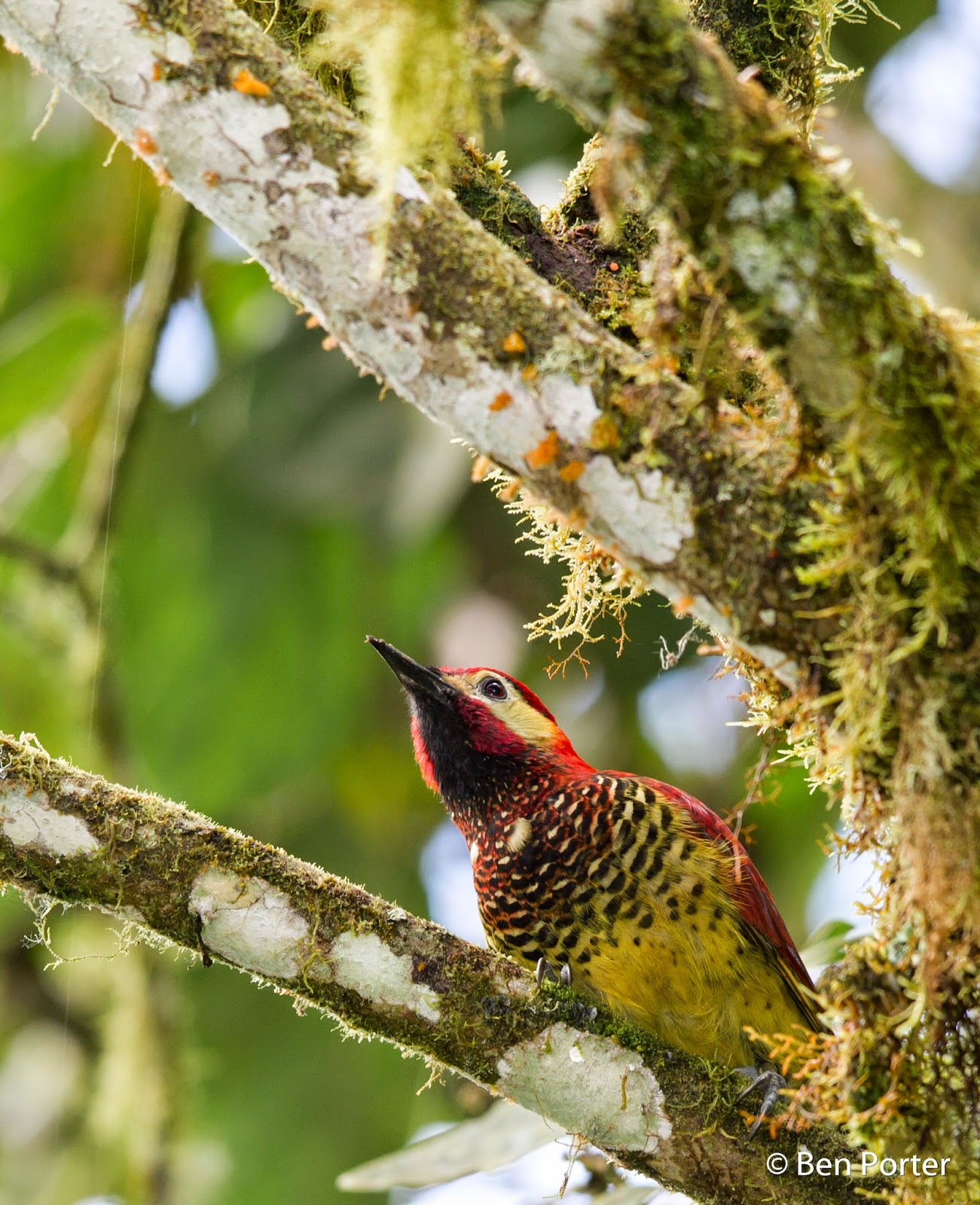
Crimson-mantled Woodpecker. This is one of two species that we have at Bellavista, and is certainly the most colourful.

As I eluded to earlier, we are now into the nesting season over here, with over 15 species nesting around the various trails at Bellavista. Turquoise Jays were gathering nesting material around the lodge a few weeks ago, and now a nest has appeared on one of the trails. It was particularly cool to see the nest of this Collared Inca hummingbird (right)- a beautiful little cup overhanging a small waterfall on one of the trails

Some insects...
A rather stunning moth!

Bullshorn Spider- a small but very impressive species found around the trails

Millipede
 And to end this post, here is an image of a very pretty flower called Nasa aequatorialis