Showing posts with label Linnet. Show all posts

Wednesday, 19 August 2015

Autumn migration update

Autumn migration seems to be very slow this year: in most years, the numbers of bright yellow juvenile Willow Warblers begins to rise from mid-July onwards, as birds begin their southward migration to Sub-Saharan Africa. Occasionally these numbers can reach peaks of 1000 (2nd August 2011) in early August. However, this year has seen very low numbers, with counts barely rising into the double figures during the whole of July and first part  of August. These lower than average numbers were mirrored in other species such as Sedge Warblers and White Wagtails, whilst hirundines have had some good passage days during the last few weeks. Most of this is down to the weather, with very unsettled conditions bringing windy and wet weather for prolonged periods during the summer.

The last week has seen a slight change, with calmer conditions encouraging some bigger arrivals and interesting sightings. On the 14th we had an arrival of almost 400 Willow Warblers, accompanied with 34 Spotted Flycatchers, two Garden Warblers, one Blackcap, four Chiffchaffs, five Whitethroats and three Goldcrests; in addition, recent days have seen Tree Pipits, Whinchats, Yellow Wagtail, Song Thrush and Short-eared Owl stopping off on the island. With the recent new moon, the high tides have brought a good deposit of seaweed onto Solfach, which has in turn encouraged a good number of waders to its shore. Peak counts have included 10 Ringed Plovers on the 16th, 25 Dunlins on the 15th, three Bar-tailed Godwits and a Whimbrel on the 17th, 32 Curlews on the 16th, 11 Redshanks, six Common Sandpipers and 12 Turnstones on the 17th, whilst scarcer visitors comprised a female Ruff (14th-16th), Green Sandpiper (17th), and three Bar-tailed Godwits (17th).

Sightings of rarer visitos to the island have been frequent in the last week: a single Great Crested Grebe off the coast on the 12th was surprisingly followed by a flock of five on the 13th- this is a very rare bird on the island, with no records for over 10 years before 2014! A Greater Spotted Woodpecker on the 13th was a good record too, and this bird stayed for a few days in the more wooded areas of the island. On the 16th, a large white bird was picked up flying south-west a mile or two off the coast. After a while, it became clear that it was an egret of some kind, and judging by the size, a Great White Egret! The island third record!

After a stunning few days, the weather looks to be breaking up in the following week, which will bring a good selection of seabirds past the coast, but conversely will not favour the arrivals of the smaller migrants on the island. Here is a selection of images from the last couple of weeks:

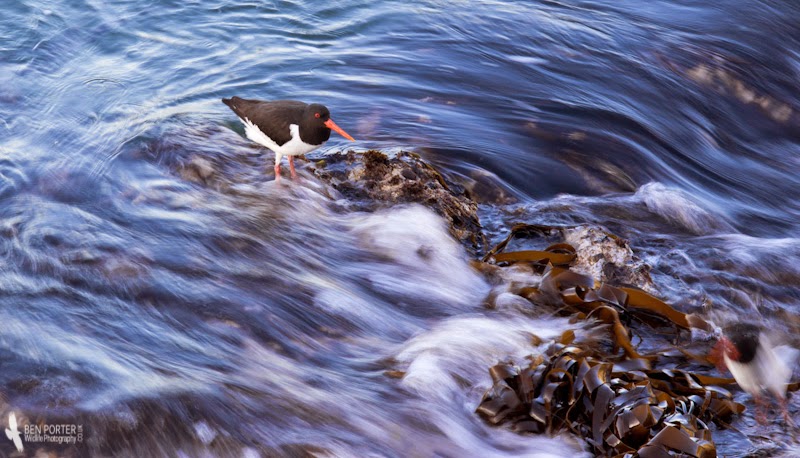
An adult and juvenile Oystercatcher roost amidst the breaking waves

many of the Turnstones are smart summer-plumaged birds

Kestrel


Willow Warblers are by far the most numerous migrant on land at the moment, but 90% are now adult birds (above). We have missed out on the large movement of bright juvenile birds that takes place earlier in the month. 

Juvenile Sedge Warbler

Whinchat- there have been a couple of birds present in the last week

Linnet numbers have increased substantially in recent days and weeks, with daily counts over 320 at the moment. Many are feeding in the oat and borage mix planted at the north end


the female Ruff spent a good few days feeding amongst the waders in Solfach

juvenile Dunlin

A Grey Heron flying in front of the buildings of Bardsey Bird and Field Observatory

Friday, 5 June 2015

Storms and Seabirds

I have been quite busy in the last few days, as the weather has finally calmed down (a little bit!) and allowed for access to the island's seabird colonies on the East Side. I have been helping out counting and ringing a broad selection of species on the island's rocky cliffs. We have made some good progress in counting nests and breeding pairs, although many of the breeding species are still just a little behind in terms of ringing- almost all the auks are still on eggs. Some of our highest counts have included 30 Fulmars, two Storm Petrels, two Cormorants, 72 Shags, 267 Kittiwakes, 1000 Guillemots, 1595 Razorbills and 41 Puffins.

In addition to the breeding seabirds, it has been great to start seeing some emerging lepidoptera and insects around the island. Yesterday's very calm and sunny weather encouraged a great selection of micro and macro moths out during the day, including the year's first Thrift Clearwing, hundreds of Celypha cespitana and Lobesia littoralis, Teleiopsis diffinis, Bryotropha terrella, Elachista argentella, Rush Veneer and Pyrausta despicata. Fresh avian migrants have been very thin on the ground, although the last two days have been reasonable, with double figure counts of Spotted Flycatchers, along with a scattering of Reed Warblers, Whitethroats, Garden Warblers, Blackcaps, Chiffchaffs and Willow Warblers. A smart first summer female Red-breasted Flycatcher was great to see and ring this morning.

Here is a selection of images from the last week:

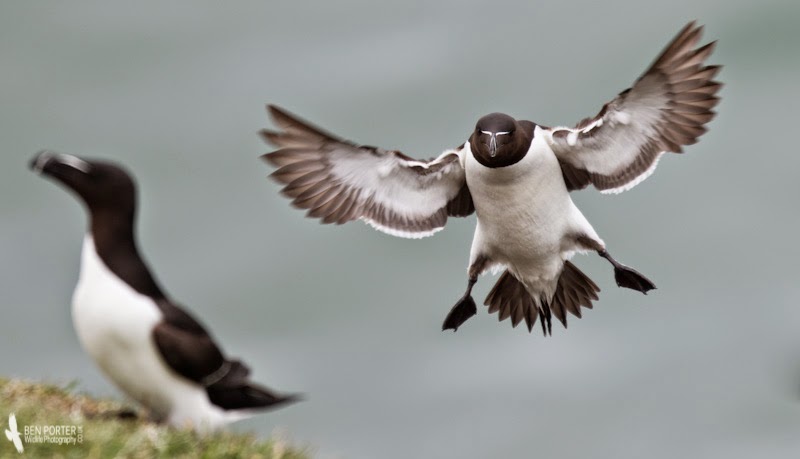
I used a Canon 15mm fisheye lens on my 7D mkII to get some close-up landscape images of these Razorbills. They were very tame and thus allowed a close proximity. This worked really well for grabbing some wide-angle shots. I hope to be able to continue this project and produce a few more interesting environmental images

The howling south-westerly gales produced some very impressive swells and rolling breakers around the coast. It was tricky to capture any decent images of passing seabirds because of their distance from the shore. This was my best attempt at a Manx Shearwater

Kittiwake on the East Side

There are a minimum of three, and perhaps as many as five pairs of Little Owls on the island this year. One or two of the pairs are quite predictable in where they show, and so some reasonable images can be taken. This bird has been sitting out on a regular perch just above our house on the mountainside. Although they are obviously nesting in one of the banks nearby, we have been unable to locate the nest as yet

It has been great to see so many Spotted Flycatchers around the island in the last few days. Some years we can have triple figure counts, but this year has been more of a steady trickle. Over 20 have been several times in the last week. 

Linnet

There are a lot of Wheatears around the coast feeding hungry chicks at the moment, and the combination of the vivid emerging thrift makes for some pretty stunning views and spectacles

A Sanderling treading water

You can also view my images at the following links: 


Tuesday, 26 May 2015

Spring news

It has been a pleasant few weeks on the island, with a thoroughly mixed bag of weather conditions: most of the time these conditions have not at all been typical of mid-May! Strong winds with horizontal rain; chilly northerly breezes with clear skies and starry skyscapes; and then more recently calm winds, glorious sun and warm temperatures. The unsettled conditions has meant that generally the last few weeks have been very poor for migrant bird numbers on the island. Usually in May we have a few days when the island is covered in Sedge Warblers, Spotted Flycatchers and Whitethroats, but this year we have had much lower numbers- the highest day counts for these species has been 34, 25 and 25 respectively. We have had some good movements of hirundines, with over 1000 Swallows, 300 House Martins and 150 Sand Martins recorded on the 15th. A scattering of Whinchats, Yellow Wagtails, Common Redstarts, Tree Pipits and Reed Warblers has been the best of the rest.
Here are a handful of images from the last week or two:

Puffins are now incubating egss in their excavated burrows on the East Side. There have been around 40 individuals sat on the sea adjacent to the slopes on the last few visits, although there also appears to be a new colony on Pen Cristin this year
Razorbills are back in force on the island, with well over 1000 present on the rocky bouldery areas around the East Side. Many are on eggs, although we have not been able to see any chicks as yet


Oystercatchers are incubating too, although the first few nests with 'fledged' young have been recorded, so the birds will now get even more furious when people pass them by

Linnet taking a bath in a small puddle along the track

Green Tiger Beetle

Gorse Shield Bug

Garden Tiger caterpillar

Buff Tip 

Wednesday, 6 May 2015

Spring Migrants: Linnets

Ok, so a Linnet is perhaps not what you might think of as a spring migrant, but they do in fact move south-west in the wintertime, and some UK birds may even move to France and Iberia for the winter, just the same as our Chiffchaffs. There are approximately 35 pairs on the island, although this varies year to year. This year we have over 200 Linnets on the island at the moment, although how many of these will go on to breed. This species is in decline in the UK, listing its conservation status as Red. Linnets can live up to eight years, and their name may perhaps stem from their old scientific name of Linarius cannabina. The meaning of this can be translated as Linarius= linen weaver and cannabina= hemp. A cool name which has unfortunately changed now that it is Carduelis cannabina. I have been photographing the island's Linnets on and off for the last few weeks, especially when the females were busy gathering nesting material....first bits of dried grass and twigs, then the hair of cows and sheep, and then wool to line their little gorse-dwelling.

Male Linnet beginning to show through with its handsome red

Female Linnets collecting nesting material It was interesting to note that, despite travelling around in pairs to collect material, the males never seemed to participate in the gathering- it was always the females that stuffed their beaks full of whatever, and then flew back to the next to construct the nest


Two days ago I decided to set up my small photographic hide near a pool along the track. Many of the Linnets were coming down to bathe and drink in this puddle at the heat of the day, which made for some good photographic opportunities: