Showing posts with label Spring. Show all posts

Friday, 12 June 2015

CRETZSCHMAR'S BUNTING!!!

Full account of the story:

Well, it has been quite an 'interesting' few days. The whole saga began back on Wednesday, at about 11 o'clock in the morning. Elfyn Lewis and Ieuan Bryn were walking up the main track towards Nant, when a bird dropped down onto the track in front of them. It fed on the rough ground for a minute or more, allowing Elfyn to take some stunning shots, and also take in a variety of features which lead him to think that it was one of the rarer Emberizia buntings. After a little while, the bird dropped over the wall adjacent to the track, and appeared to drop into a nearby field. Elfyn then went immediately to the obs, where he showed Steve Stansfield the images...Steve confirmed that the bird was in fact the rarer of the two possibilities, and that we had a flipping spring male CRETZSCHMAR'S BUNTING on the island!! The news went straight out on the radio- I was helping with some work in the withies, which is about 200 metres away from where the bunting was seen. We all gathered to the site where it had been seen, but there was no obvious sign. A few glances at Elfyn's images on the back of the camera produced a mix of responses all around, mostly involving expletives.

A search ensued in the next hour, initially focussing on the area around Plas (where it had been found), and then all observers began to split up and cover wider areas: the mountainside, the track, a ploughed field at the North End, and the meadows. It was about an hour later that the call came through on the radio from Steve Hinde (working at the observatory) who had just seen the bird drop onto the track from the garden at Plas- right back where it was initially seen, and where we had all been searching not long before!! Panic-stricken birders all began stumbling towards the site, but literally seconds before arriving, Steve had the bird fly from the track and into the back garden of the observatory! We all spent the rest of the afternoon (from about 1230 onwards) searching for the little beast. We surrounded the obs garden, scoured the hillside, patrolled the track, and desperately searched the coastline...all to no avail. It was to a pretty bleak outlook and depressed state that most of the island's birders and observatory staff went to bed that night.

Fast forward to yesterday (12th June)...after not a single whiff of the bird on the 11th, despite thorough searched, we were in for a big surprise. It was mid-morning, and I had just been out in my rowing boat, and was talking to Steve and Steffan (warden+assistant), when one of the members of the Dyfi osprey group who were on for the week came walking briskly towards us. He told us that Elfyn and a few of them had just had the bird singing on the South End wall!!! Steve and Steffan immediately started running towards the site, whilst I had to speed in the other direction back up to my house to grab my bins and camera. Managing not to run anyone over with the quad bike, I arrived and grabbed my stuff, before speeding back down the track on my bicycle. I was half way down to the South End, when I had to stop to open a gate. As I opened the gate, I suddenly saw the bunting take off from the track ahead of me, fly in a tight circle around me, and then head off towards the observatory over the wetlands!!! I was taken aback a little, by seeing what basically looked like an Ortolan in flight, apart from being blue and orange! I picked up my radio and was relaying the news as it occurred. Steve, Steffan, and the rest of the birding gang who had re-located the bird joined me to try and relocate the bird.

We headed up towards the observatory through the wetlands and up the track, but there was no sign. I was about 200 metres from the obs when I heard the distinctive dry 'glip---glip' call of a bunting coming from a northward direction. I looked up and got onto the bird, which seemed to fly out of the obs garden and then head south-east up the mountainside. It landed briefly on a gorse bush, before dropping out of view. Once again we had to set up a thorough search of all possible areas, starting with the gorse patch on which it alighted. After a fruitless search, myself and Mark Carter were looking around in the small bay of Traeth Ffynnon, when Mark suddenly exclaimed 'I have got the bird!!!'. It was feeding on some dry earth just in front of us. We radioed out the news, and just a few minutes later most of the obs staff and visiting birders were staring at this stunning bird. It fed out in the open for a little while, before flying down onto a small prominent, and then disappeared into thin air, not to be seen again...

Several boat trips were organised for mainland birders to attempt to connect with the bird, including local North Wale birders Steve Culley, Reg Thorpe, Julian Hughes, Simon Hugheston-roberts, Chris Jones and Eddie Urbanski in the evening of the 12th. Unfortunately, several boat loads of unhappy birders had to depart, with no further sign of the bird. Will it turn up again?

What makes this Cretzschmar's Bunting so special
  • first ever record for Wales
  • sixth record for the UK
  • first time the species has been recorded south of Northern Scotland 
  • the first record for Britain turned up on 10th June 1967 on Shetland
  • it should be singing on the rocky outcrops Mediterranean hillsides in countries such as Greece
  • IT IS A MALE, and is stunning...
A big congratulations to Elfyn Lewis for this mega find!!


Friday, 5 June 2015

Storms and Seabirds

I have been quite busy in the last few days, as the weather has finally calmed down (a little bit!) and allowed for access to the island's seabird colonies on the East Side. I have been helping out counting and ringing a broad selection of species on the island's rocky cliffs. We have made some good progress in counting nests and breeding pairs, although many of the breeding species are still just a little behind in terms of ringing- almost all the auks are still on eggs. Some of our highest counts have included 30 Fulmars, two Storm Petrels, two Cormorants, 72 Shags, 267 Kittiwakes, 1000 Guillemots, 1595 Razorbills and 41 Puffins.

In addition to the breeding seabirds, it has been great to start seeing some emerging lepidoptera and insects around the island. Yesterday's very calm and sunny weather encouraged a great selection of micro and macro moths out during the day, including the year's first Thrift Clearwing, hundreds of Celypha cespitana and Lobesia littoralis, Teleiopsis diffinis, Bryotropha terrella, Elachista argentella, Rush Veneer and Pyrausta despicata. Fresh avian migrants have been very thin on the ground, although the last two days have been reasonable, with double figure counts of Spotted Flycatchers, along with a scattering of Reed Warblers, Whitethroats, Garden Warblers, Blackcaps, Chiffchaffs and Willow Warblers. A smart first summer female Red-breasted Flycatcher was great to see and ring this morning.

Here is a selection of images from the last week:

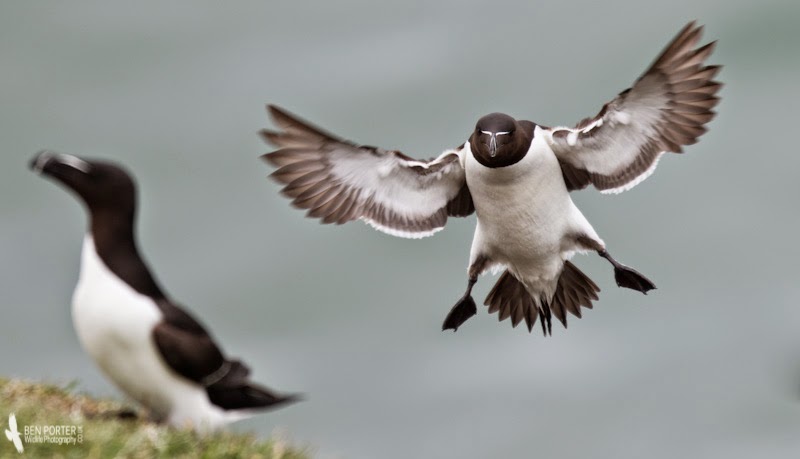
I used a Canon 15mm fisheye lens on my 7D mkII to get some close-up landscape images of these Razorbills. They were very tame and thus allowed a close proximity. This worked really well for grabbing some wide-angle shots. I hope to be able to continue this project and produce a few more interesting environmental images

The howling south-westerly gales produced some very impressive swells and rolling breakers around the coast. It was tricky to capture any decent images of passing seabirds because of their distance from the shore. This was my best attempt at a Manx Shearwater

Kittiwake on the East Side

There are a minimum of three, and perhaps as many as five pairs of Little Owls on the island this year. One or two of the pairs are quite predictable in where they show, and so some reasonable images can be taken. This bird has been sitting out on a regular perch just above our house on the mountainside. Although they are obviously nesting in one of the banks nearby, we have been unable to locate the nest as yet

It has been great to see so many Spotted Flycatchers around the island in the last few days. Some years we can have triple figure counts, but this year has been more of a steady trickle. Over 20 have been several times in the last week. 

Linnet

There are a lot of Wheatears around the coast feeding hungry chicks at the moment, and the combination of the vivid emerging thrift makes for some pretty stunning views and spectacles

A Sanderling treading water

You can also view my images at the following links: 


Tuesday, 26 May 2015

Spring news

It has been a pleasant few weeks on the island, with a thoroughly mixed bag of weather conditions: most of the time these conditions have not at all been typical of mid-May! Strong winds with horizontal rain; chilly northerly breezes with clear skies and starry skyscapes; and then more recently calm winds, glorious sun and warm temperatures. The unsettled conditions has meant that generally the last few weeks have been very poor for migrant bird numbers on the island. Usually in May we have a few days when the island is covered in Sedge Warblers, Spotted Flycatchers and Whitethroats, but this year we have had much lower numbers- the highest day counts for these species has been 34, 25 and 25 respectively. We have had some good movements of hirundines, with over 1000 Swallows, 300 House Martins and 150 Sand Martins recorded on the 15th. A scattering of Whinchats, Yellow Wagtails, Common Redstarts, Tree Pipits and Reed Warblers has been the best of the rest.
Here are a handful of images from the last week or two:

Puffins are now incubating egss in their excavated burrows on the East Side. There have been around 40 individuals sat on the sea adjacent to the slopes on the last few visits, although there also appears to be a new colony on Pen Cristin this year
Razorbills are back in force on the island, with well over 1000 present on the rocky bouldery areas around the East Side. Many are on eggs, although we have not been able to see any chicks as yet


Oystercatchers are incubating too, although the first few nests with 'fledged' young have been recorded, so the birds will now get even more furious when people pass them by

Linnet taking a bath in a small puddle along the track

Green Tiger Beetle

Gorse Shield Bug

Garden Tiger caterpillar

Buff Tip 

Thursday, 21 May 2015

Oystercatchers

No stretch of coastline around the UK is complete without at least a few pairs of Oystercatchers. Bardsey is home to about 80 pairs, which breed around the entire coastline year after year. From mid-Spring to late Summer it is rather hard to go for a walk anywhere near the sea without setting a pair up into the air with their loud piercing alarm calls, and with the ferocious attacks in some situations. They are, despite becoming rather annoying as the year progresses, pretty charasmatic birds that are certainly on of the most obvious things that pop into mind when you think of the coast. (well, certainly for me, at any rate).

At the moment, all of the pairs around the island are incubating eggs, which are laid in a small scrape on a rocky ledge or shingle beach. Both the males and females can share incubating duties, although most often it is the female. The period of incubation is between 24 and 27 days, whereafter it can often take another few weeks before the chicks fledge. The young are said to be precocial, which just means that they hatch out at a fairly advanced stage of development, leaving the nest very soon after hatching, find their own food, and follow their parents.

An interesting fact about Oystercatcher chicks is that, due to the species' very specialised feeding habit, the young will often remain with the parents for weeks so that they may learn the techniques involved in extracting bivalves from their tough shells. It has even been said that the young may associate with their parents for up to a year after fledging.

I have made a bit more of an effort to photograph this species in its element this year, with a mixture of long exposures and finding the right locations for atmospheric shots. Here is a selection of images from the last week, taken with Canon 7Dmk II and Canon 300mm f2.8 + 1.4x converter.

A few nights ago I was out in the evening when a very heavy rain storm arrived. Instead of running back to the house or nearest shelter, I took the opportunity to try and get some more atmospheric images of a few Oystercatchers which were perched on some rocks not far away. With a strong wind, the rain was almost horizontal, and got very heavy indeed. Sheltering behind my camera bag, I was really pleased when the sun dropped below the rain cloud on the western side of me, and so backlit the rain in a really nice way. I experimented using different shutter speeds to get the most desirable effect on the rain

There are around 80 pairs of Oystercatchers nesting on Bardsey, and they are all incubating eggs at the moment. I used a remote shutter release and fisheye lens to capture this bird on a nest on Solfach. This bird is relatively tolerant of human presence on the beach, due to the number of visitors that visit

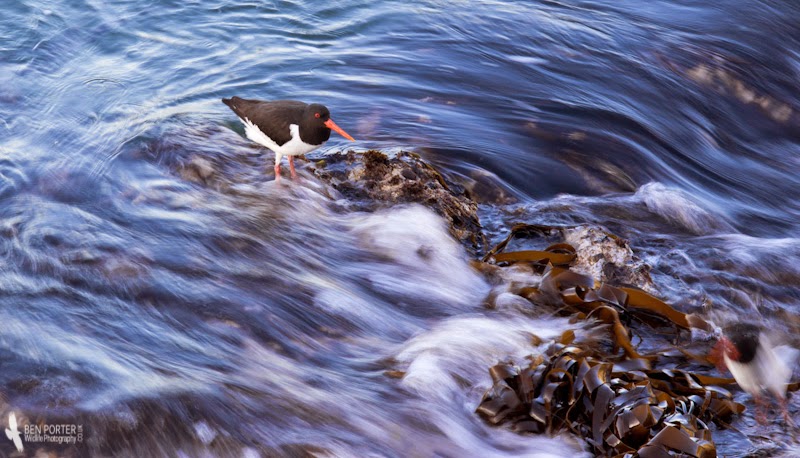
For this image I used a slow shutter speed of 25th second to capture the slightly backlit waves crashing on the rock. This type of image is one that I have really been experimenting with this year

A somewhat perturbed Oystercatcher reacting to me being a bit too close to their hidden nest

A couple more

Monday, 11 May 2015

Spring soldiers on

Well! It is hard to believe that it is almost mid-May, what with the recent chilly temperatures, almost constant strong winds and frequent rain storms. The conditions are more typical of mid-winter, but the wildlife continues to soldier on, and you do not have to look far before seeing the signs that Spring is in fact in full swing: the Mountain's East Side is now a carpet of pink Thrift, which contrasts with the west side of the Mountain, which is a vivid yellow from the Gorse; Oystercatcher pairs all around the coast are now incubating eggs in their small scrapes, whilst hundreds of seabirds on the cliffs are well into breeding, with some Shag pairs already rearing their ugly chicks. The vegetation around the island is shooting up after the recent rain showers, despite the wind and temperatures, although the same can not be said for the island's lepidoptera: the low temperatures have severely affected catch numbers in the moth traps, with the highest catches being no more than 10 individuals of five species. Green-veined Whites are beginning to increase in numbers, and the first Painted Lady of the year put in an appearance today. I have taken plenty of images over the last week or so, although the weather has restricted certain things...here is a selection of some of my favourites:

 This image is the first of a new project that I am beginning along the line of macro photography: using a fisheye lens to bring in a bit more of the environment, whilst still retaining interest in the main subject. This Honey Bee was feeding on the coastal Thrift on the East Side, and I used a Canon 7D mkII and Canon fisheye 15mm lens to get very close to the insect, but try and capture a bit of the background and foreground. There are plenty of niggling things wrong with the image, such as the awkward composition, although I am pleased with it as a start

Whilst carrying out a morning ringing session at the northern end of the island, this male Sparrowhawk flew into one of the mist nets. It was a rather pleasant surprise, and after extracting it, I took to the observatory for the ringing procedure. This image was taken with a Sigma 105mm f2.8 macro lens just prior to release

The last week has been excellent for Cuckoos, with tree present on one day a few days ago. Two male birds feeding along a fence line at Nant presented a good photographic opportunity, so I set up my small hide and managed to grab the lower image before a huge rain storm set in for the rest of the day. The first two images were taken the next day, when a female bird present in the Withies proved to be quite an approachable bird


Shellducks in the rain- taken on a rather grim day, with lashing rain, very strong south-westerly winds and a high tide. The combination of conditions did, however, make for some interesting angles and images, with the bird coming very close to the hide on Solfach

Some pairs of Stonechats have already fledged their first broods of young, and are now busy trying to find enough food to stuff down the bright gapes of the chicks

A flight shot of a Razorbill from yesterday. There are many hundreds in the rocky boulder fields and cliff areas around the East Side now, many of which are likely to be on eggs

Friday, 8 May 2015

Spring Waders

With the weather conditions very much up and down at the moment, there have been plenty of days when common passerine migrants have been very thin on the ground. The strong south-westerly winds and accompanying rain showers have, however, turned up a neat variety of waders around the coast of the island. This appearance has been helped by the recent full moon, which has increased the tide heights and thus forced many waders onto a much shorter area of coastline. I spent a morning in Solfach Hide a few days ago, watching Whimbrels, Ringed Plovers, Dunlins and Common Sandpipers coming and going, feeding along the edge of the sea. The driving rain allowed for some more atmospheric images to be taken, as can be seen below. I hope you enjoy this selection of pictures:


Whimbrels in flight. These were taken with a Canon 7D mk II, a Canon 300mm f2.8 and a Canon 1.4x converter. I was quite pleased with the performance of the 7D in the low light in the top few images, with minimal noise levels.


The top image is of an Oystercatcher taking off from a rock as a large wave rolls in. This bird is underlit by the sea foam and spray below. Again, this was taken with the following: Canon 7D mk II, Canon 300mm f2.8 and Canon 1.4x converter. The second image is the same bird before the wave hit!


 I spent a little while photographing these Ringed Plovers as they fed on the beach. I found that sitting still about 6 metres from the waters edge worked well, as the birds would work the length of the beach, and when they came past me they would sprint as fast as they could until they were a little further away. In the upper image, I used a shutter speed of 1/150th sec to try and capture a bit of the speed


Common Sandpiper


Dunlin numbers are really starting to build up now, with around 10 individuals on the beach most days. I am sure there will be a blog post to follow focussing exclusively on this species, but here is a quick shot of one running past