Showing posts with label Garden Spider. Show all posts

Sunday, 31 January 2016

Falmouth night life - the wild side

Over the last few weeks, myself and a number of friends here in Falmouth have spent a lot of time searching for invertebrates during the night-time. Although a walk around nearby College Reservoir during the day would indicate that there aren't too many insects braving the winter conditions, the exact same places play host to an impressive diversity of all sorts of wildlife when darkness falls. Will Hawkes has been conducting invertebrate transects from the campus on a weekly basis thus far this year, and has recorded over 300 species already! It really is amazing to get out and see such a diversity of species emerging from the nooks and crannies in the most unexpected of places.

For some species, these alcoves and warm hide-aways are the site for their winter hibernation, for example the cluster of six Herald moths huddled together underneath a motorway overpass; other invertebrates are utilising the above-average winter temperatures to emerge early and spend time foraging for prey and food when the night has drawn in. Presumably emerging at night avoids the costly predation effects associated with daylight. I will depict just a handful of the species we have encountered below, and try and include some of the more fascinating ones too!

Particular highlights for me has been learning to identify the diverse range of arachnids, isopods, myriapods and dipterans that reveal themselves on the calmer nights. Spiders are by far the most abundant genus currently at large, with impressive beasties like Snake-back Spider, Buzzing Spider, Noble False Widow, Walnut Orb Weaver and European Garden Spiders to name but a few. If you have a spare hour or so on one of these dark winter nights, why not take a walk to a local wood or peer into you log shed to see what amazing creatures are taking refuge?

Some useful identification resources online include:
 - Naturespot
 - UK Safari
 - UK Wildlife Trusts

Hundreds of these Orb-weavers are around at the moment, called Zygiella x-notata. They prefer the metal railings and other such manmade structures on which to construct their webs. These webs have a characteristic shape, consistently missing one of the radial segments and thus giving the appearance of a gap in the web
I was surprised to come across some 30 Common Toads (Bufo bufo) around the local reservoir a few nights ago. Most seemed to be male, and were stood alert in the middle of the path. Hopefully they will find enough food to keep them tied over until later in February, as disturbance from hibernation can severely affect their ability to last out on their winter fat reserves

These smart Common Shiny Woodlouse are amongst around four different species of isopod commonly encountered at the moment: the other three are the Common Rough, Common Striped and Dwarf Red Woodlouses

It has been great to come across three different species of shieldbug already this year, including this handsome Hawthorn Shieldbug, several Gorse and a handful of Common Green Shieldbugs

Although of a minute size, these characterful little springtails are pretty cool creatures: they can propel themselves into the air with the equivalent force of a nine caliber bullet from a Revolver!

Onto the spiders...(so don't continue if you are an arachnophobe!)
These stunning beasties are the species are at the head of a fierce misunderstanding on the public's side: the Noble False Widow Spider (contrary to popular belief) can administer a bite only as painful as that of a mild bee sting, although is unlikely to do so unless carelessly provoked. There are three species of widow spider that occur in the UK, all of which are quite similar, but Steatoda nobilis takes the lead in terms of size (they can grow over 15mm)

This smart specimen is one of the rarer species we have come across: the so-called Snake-back Spider

Walnut Orb-weavers are attractive members of the Araneae family that are strictly nocturnal, emerging on their spun webs to trap flying insects and winged prey

A delicate-looking species which seems to be one of the commonest currently around Tetragnatha extensa is particularly numerous at the moment

Although not a great picture, this is a fascinating species: the Buzzing Spider (Anephaena accentuata). During courtship, the male of this species repeatedly taps his abdomen on an underlying leaf to produce an audible buzzing sound that presumably acts to entice females to mate 

Friday, 11 December 2015

Photographic Advent Calendar, Day 10: European Garden Spider

Although autumn is well and truly passed now, it doesn't feel like too long ago when every hedge and patch of scrub was adorned with the delicate webs of an amazing little architect: the European Garden Spider (Araneus diadematus). Throughout the autumn months, Will Hawkes and I spent a lot of time studying a variety of different insects around campus, and I have to say that this remarkable beast has to be one of the coolest...if a little under-appreciated by many.
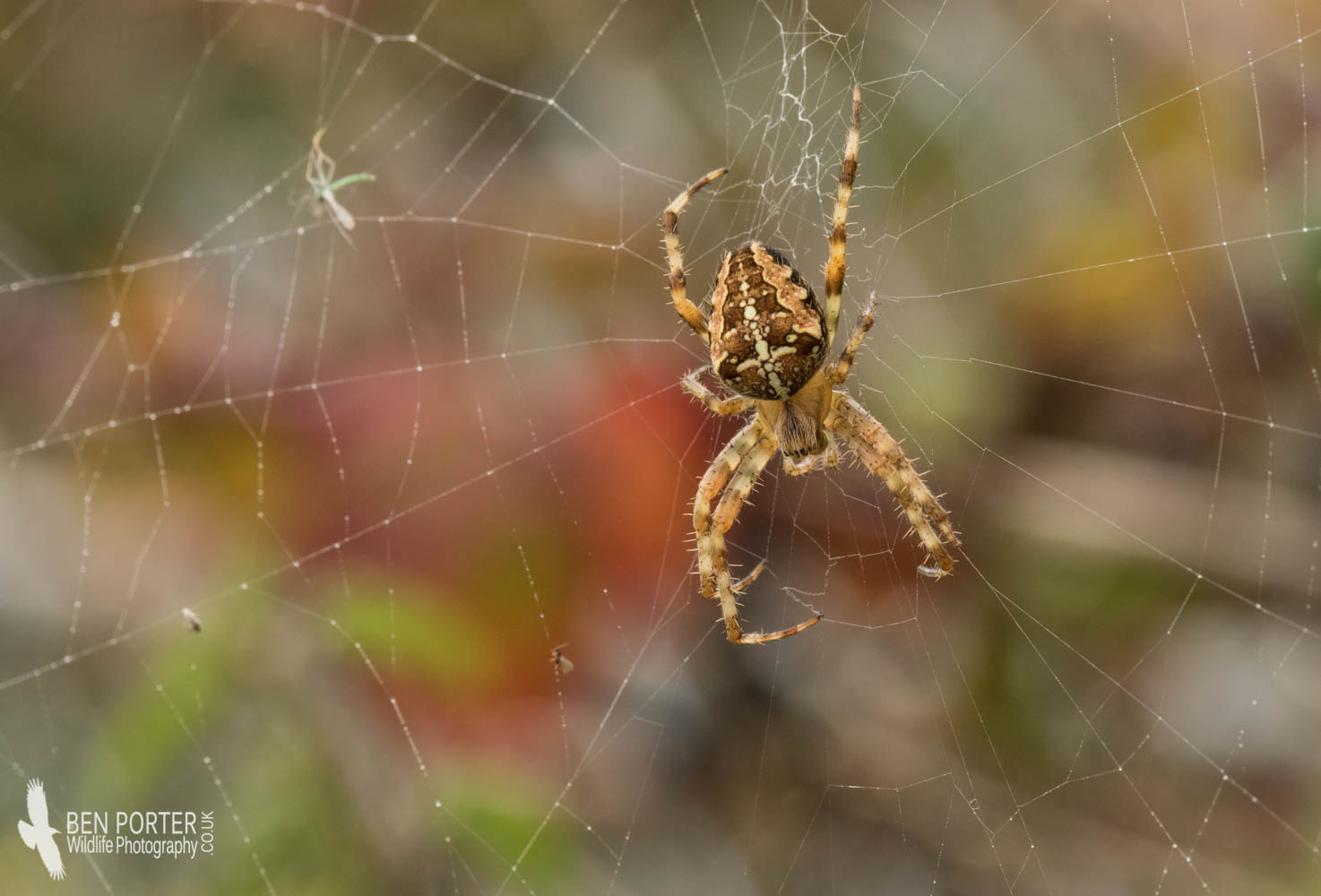
I wrote a fairly detailed blog post dedicated to this species a while ago, so check out the link to see that...but I shall give a shortened summary for my 10th Advent Blog post. The European Garden Spider is amongst the family of arachnids known as Orb-weavers.  This species, like many others in the Araneidae family, spin large orb webs to snare unwary prey. Typically about 13mm in length in females, and up to 8mm for males, they can grow to a chunky size- the former in particular can spin sizeable webs capable of catching a diverse range of prey items, from butterflies and grasshoppers through to midges, shieldbugs and species of bees and flies.

The construction process of a web is incredibly detailed and carried out sometimes daily. Firstly, the radials are connected together from an initial 'throw line', resembling the spokes of a wheel. The spider will then set about adding the lethal sticky circular threads, using its abdominal spinneret to secure the line to each radial along the ay.  During the whole construction process, the spider uses a non-sticky spiral of thread attached from the centre to the periphery to move around, which stops its own entanglement in the web! Once finished, the Garden Spider will often rest patiently in the centre in wait of prey. And it is at this stage that, given a particularly misty morning, we can fully appreciate their work; Spider's webs covered in dew droplets possess a certain beauty that enables us to appreciate all their hard work.


Saturday, 10 October 2015

Orb-weaving Spiders: nature's great architects

In this blog post I shall be focusing solely on the beautiful and fascinating Garden Spider (Araneus diadematus). This species is a member of the typical orb-weaving spiders (family Araneidae), and is one of the the most noticeable arachnid species encountered from July through to November, occurring across the UK in gardens, hedges, parks and scrub.

Anyone rising early in the last few weeks on a calm, crisp autumnal morning may have been treated to the stunning display of orb-webs that cling delicately to areas of scrub, hedgerows and other favourable hunting grounds. If you are really lucky, then a heavy dew may have descended overnight and vividly highlighted the individual strands of the webs with small water droplets, turning the webs into a beautiful piece of art. This has certainly been a common, and very welcome, sight for me in the last few weeks, and has lead me to try writing a short piece about these superb creatures...

Garden Spiders and their beautiful webs in the early morning light, taken at a nearby nature reserve called the Bissoe Valley

So, who do we have to thank for adding these ethereal scenes to our early mornings? The culprit is the humble Garden Spider, Araneus diadematus. This species, like many others in the Araneidae family, spin large orb webs to snare unwary prey. Typically about 13mm in length in females, and up to 8mm for males, they can grow to a chunky size- the former in particular can spin sizeable webs capable of catching a diverse range of prey items, from butterflies and grasshoppers through to midges, shieldbugs and species of bees and flies.

Female Garden Spider lying low after a bought of heavy rain overnight. I wonder what effect dew and water droplets have on the catch of Orb-weaving Spiders?

The pregnant females are particularly bulging in appearance, due in no small part to the swelling of eggs. These will be packaged into a silk egg sac, which is laid onto branches, in sheds, or in other such sturdy places. The small eggs will hatch out in the spring, into a burst of tens of small yellow Spiderlings. These will then disperse, grow, and eventually set about building their own delicate masterpieces- with no tuition or input from the now-deceased mum.

Another female Araneus diadematus, clinging onto to its central cluster of threads. This web has had a productive day's catch, as can be told by the 'by-catch' items that have just been left. My friend and excellent photographer Will Hawkes is undertaking an interesting study into the relationship between size of spider and number of prey items left over (i.e. not consumed)

So how do they actually construct these architectural masterpieces? It is amazing to think that these spiders are able to spin webs across gaps which they can't actually physically cross, and which can be over 50 times the length of the spider! As a side note before I attempt to summarise the process, it really is worth watching this super cool time-lapse of a Garden Spider creating its web.
To begin the process (which the Orb-weavers typically carry out at night, before the main 'hunting' period during daylight hours), the spider spins a very fine thread of silk, which it allows to drift from one side of a gap to the other. Once this thread has made contact with the far side, it adheres and allows the the spider to pull it tight and strengthen it numerous times with additional threads. Once the main thread is strong enough to support the rest of the web, two additional threads will gradually be added to form a Y-shaped 'web'. This Y will be the primary foundation for the rest of the web...at this point the spider will now go about adding a number of radials to the web, which sets the base ready for the sticky circular threads. An amazing feature of this stage is that the spider will construct a non-sticky spiral of thread from the centre to the periphery, which allows it to move around during construction without getting stuck!

After strengthening the central 'perch' with about five circular strands, the spider now makes the fundamental circles of sticky threads that perform the crucial role of ensnaring victims. The spider will start from the outside moving to the centre, and will use the non-sticky spiral to move between the layers; as it makes these closely-spaced circular threads, it will remove the non-sticky spiral. The reason that the circular sections of the web are so exact in distance between each other is simply because of the way they are made: the spider picks the thread from its spinner with its hind leg, and fastens it onto one of the radials- it then repeats this as it continues round, securing the circular strands to a radial line each time one is encountered. Eventually, the web is finished, and the creator can now sit happily in the centre, and await its prey.

A web in construction, with the spider in the process of spinning the sticky circular sections as it works from the outside to the centre

Perfection: a near flawless masterpiece awaiting a productive day's hunting

The spiders use a variety of mechanisms to prevent themselves from falling victim to their own success...besides the spinning of non-stick threads in the course of construction and operation of the web, the spider also has very fine hairs and a non-stick surface on the tips of its legs which make sticking less likely. Most of the species in the family Araneidae have three tarsal claws, and the third of these is thought to have a particularly non-sticky function, thus forcing the spider to walk solely on these in some circumstances.

The Garden Spider may rebuild these webs every day, as anyone who continually walks through awkwardly-placed webs may testify. The spider will often consume what is left of the old web so that the proteins used to make the web can be recycled and re-used in the next one.  

 Another chunky female Garden Spider

Garden Spiders spinning up an unfortunate Common Green Grasshopper

When prey items become tangled in the sticky threads, the Garden Spider will quickly pick its way over to the victim, and promptly wrap it up in a layer of silk. It will then devour the victim straight away or return sometime later.

 It is great to see the sticky-ness of certain strands at work in all of the dew-covered webs above: can you see that most of the droplets are only sticking to the circular sections of the web? Most of the radial sections and the spider's central perch (non-sticky) are devoid of droplets. 


So there we are...a bit of a focus on the species responsible for the amazing webs which hang unassumingly in parks and scrubland areas all across the UK. Will you look at one of these superb arachnids in a different stead next time you see one?


References:

Saturday, 3 October 2015

A focus on the smaller side...

Over the last few weeks, it has been great to wander around the various wildlife-rich areas around Falmouth and spend a while looking at the smaller elements of nature...

Even when it is windy and dull, there is always something to look at, whether it be a bulky House Spider sheltering in a away in a hidden crevice, or perhaps a small Rove Beetle that scurries across the ground in front of you. Will Hawkes and I have had particular fun in finding a plethora of different Hoverfly and Shieldbug species lurking around the rich hedgerows and rank grassland patches nearby. We have almost encountered 10 species of the latter, whilst identifying the former is proving a little more tricky in some instances. It is great to find and observe the various forms of arthropods whilst the weather holds up and many are still actually around (not looking forward to the depths of winter!).

The spiders have been particularly entertaining, demonstrating a surprising diversity of prey items wrapped in neat packages within the webs of the Orb-weaving Spiders (Araneus diadematus). Anything from miniature midges to shieldbugs, grasshoppers, moths and even butterflies have been unfortunate enough to meet their end in these delicate structures- a few morning ago I had a great time photographing the stunning webs down at the Bissoe Valley with fellow photographer Max Thompson (see below).

Without waffling on too much, you can check out a bit of the invert diversity that we have encountered over the last week or two, and I shall try and give a bit of a caption for each :)


A couple of shots of the amazing webs of the Orb-weaving Spiders (mostly Araneus diadematus). A few mornings ago, I was at a nearby site in the Bissoe Valley and had the pleasure of photographing these stunning webs as the rising sun gave a delicate back-lighting and the light dew highlighted the strands

This little arachnid is a Zebra Jumping Spider (Salticus scenicus), a member of the Salticidae family. These species have incredibly adept eyesight, hunting primarily with the use of this sense. They move with a jerky motion over surfaces, 'hopping' or jumping using their hydraulically-powered legs

One of the many hoverfly species encountered recently- what appears to be Sericomyia silentis

A Knot-Grass Caterpillar, found in the garden on campus
Another caterpillar, this time a massive species that somehow turned up in a mist net at Nanjizal! An Eyed Hawkmoth

Some moth stuff...
I have been running my small heath trap fairly consistently outside the caravans for the last few weeks, but the catches have largely been quite low in both diversity and number. I think this is primarily due to the large moon, as last night saw over 20 moths in the trap, including some smart species like Beaded Chestnut, Autumnal Rustic, Feathered Ranunculus and Pink-barred Sallow. I am looking forward to a few more autumn moths in the coming week, especially with the use of a couple of moth traps on Uni campus grounds...
Green Carpets have been quite regular in the trap, and very welcome too!

A Copper Underwing of either of the two species- it looks to be Copper Underwing after examination of labial palps, underwings and forewing pattern, but I remain unconvinced that the two species (Svensson's Copper U vs. Copper U) can be identified on external features alone

Pink-barred Sallow- a classic autumnal moth

It has been great to see the odd Hummingbird Hawkmoth dotted around, especially this individual on campus a few days ago

Gorse Shieldbug (Piezodorus lituratus)


And now for a few 'macro'-centred images that I have taken over the last week or two (some are intentionally abstract...)

Oxeye Daisy at sunrise

Orb-weaving Spider's web 

A backlit Moss shot: Mnium hornum

Fungi of some sort- ink-caps?

Sycamore 'keys'

Fern reflections

Backlit ferns in the early morning light

Wednesday, 16 September 2015

Freshers Week - Invertebrate life

It has been superb to wander around hedgerows and areas of scrub grassland and discovery a plethora of interesting bugs, flies, moths, spiders beetles and various other invertebrates! (a typical Freshers week activity...). Will Hawkes and I (Will is a great photographer and naturalist from Llangollen, who is studying a similar course to me) have managed to crack down on a really cool variety of species, with the help of my sister and also Ellie Mahew.  Although the insect life back home on Bardsey is good at times, it is certainly very limited in its diversity, so coming to the mainland and seeing so many different species is really cool! It has been great fun learning about them and trying to track down the various IDs...I have uploaded a few images below which give a good selection of our discoveries...


 This has been one of the biggest highlights for me...a (very small) male Wasp Spider! I have always wanted to see one of these striking and beautiful arachnids, and really didn't expect to see one today as we were walking along the coastal path to Maenporth- well done Rachel! The females of this species are much larger than males, having swollen abdomens of lengths over 1cm with the stunning black, white and yellow stripes as in this one

 There seem to be an awful lot of Orb-weaving Spiders around, with hundreds of individuals lining all of the lanes and scrub hedgerows, varying enormously in size and colouration. Most of them appear to Garden Spiders (Araneus diadematus). We have seen a large variety of prey items strung out in their perfect orb webs, including Grasshoppers, Parasitic Wasps, small micro moths and many different fly species


One of the equally most numerous families seemingly plastered along every bramble hedgerow is that of the Shieldbugs: Hemiptera. The Common Green Shield-bug seems to be the most common at the moment, but there have also been large numbers of the Dock Bug on its foodplant too...
Hairy Shield Bug (Dolycoris baccarum)

 Both of the above are Dock Bugs (Coreus marginatus), but the lower individual is a late instar, showing a different colour and shape to the adult on top

Common Green Shield-bug (Palomena prasina)

Red-legged Shield-bug (Pentatoma rufipes)

Speckled Woods have been nice to see too, as we rarely get this shy woodland-dwelling butterflies over onto the island

 Field Grasshopper (Chorthippus brunneus)

Meadow Grasshopper (Chorthippus parallelus)

This cool caterpillar was hiding in the bracken alongside the path today, doing its best to blend in- and it did that rather well! This one will become a Dot Moth after pupating

One of the smaller things we've found, and what initially looked like a mini Devil's Coach-horse Beetle; it is a Rove Beetle (Paederus littoralis),