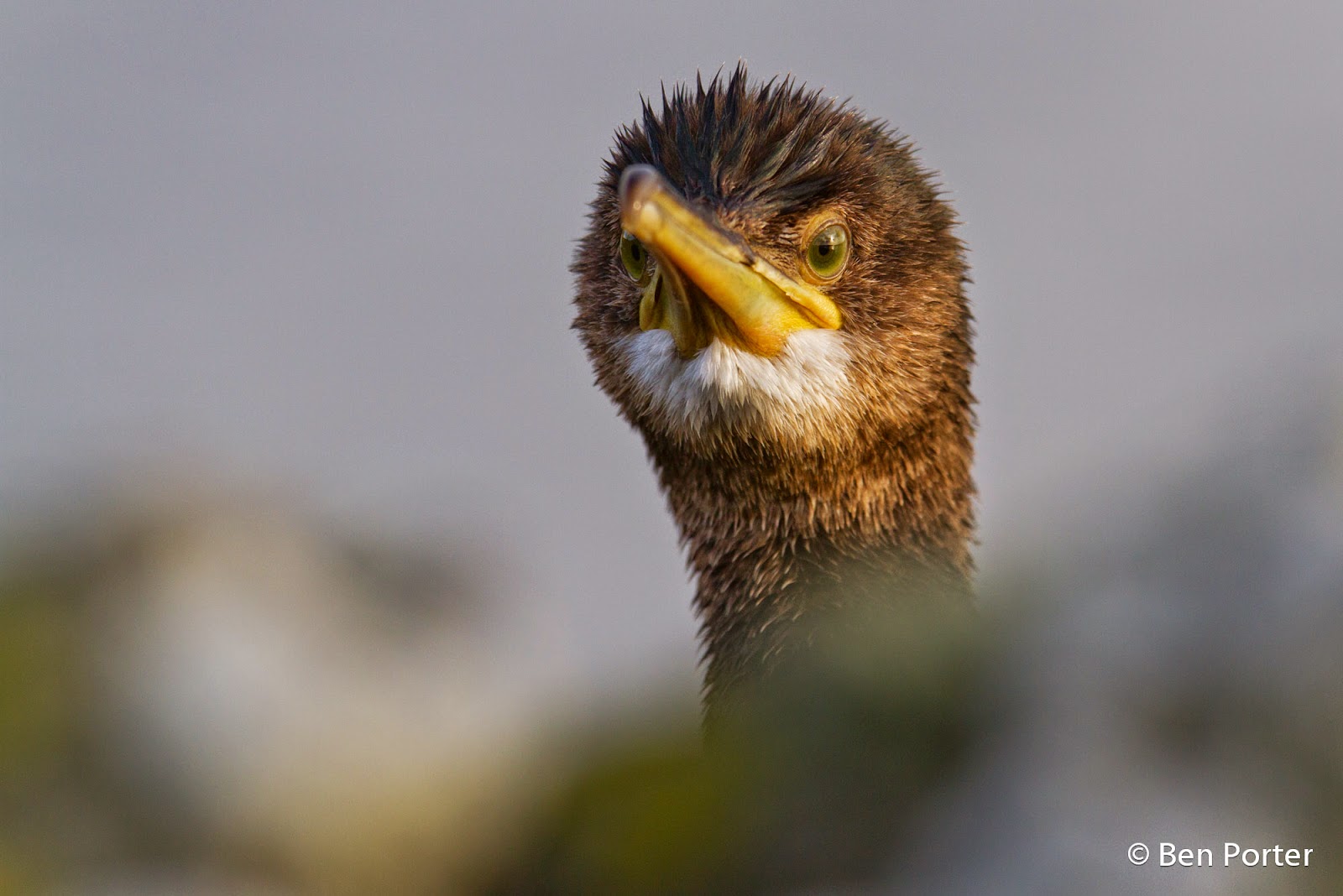
My eleventh advent blog post focusses on the European Shag (Phalacrocorax arestotelis). This is a species which can be found throughout the year around the British coast, and of which there are around 27, 000 breeding pairs. The adults develop a showy mohican-style quiff of a crest in the spring, which they show off alongside their shining green colouration and emerald-coloured eyes. They are handsome bird, despite the scientific name eluding to a 'bald raven'! (phalakros= bald, korax= the Raven). Many people often confuse the Shag with the larger cousin, the Cormorant: in contrast, the Cormorant is a good third larger, sports a chunky bill with hooked tip, blue eyes and a different facial pattern.
In the spring and summer, the breeding adults take up their places along the cliff edges around the coast; they assemble a pile of driftwood sticks, seaweed and scraps of rope into their equivalent of a 'nest'. Pairs will incubate their few eggs (typically three) for a month or so, before supplying their prehistoric-looking progeny for another month. By early July, many of their young will have taken the plunge and headed out to sea, but these juvenile birds will often congregate into loose flocks in the summer months. Over winter, extended periods of stormy weather can take their toll on young birds: on Bardsey alone we often have at least five corpses wash up every winter. Unfortunately, like the plight of many other British seabirds, this smart species is Red listed due to recent declines in populations.
Showing posts with label Shag. Show all posts
Saturday, 12 December 2015
Thursday, 11 June 2015
Seabirds - the Gwylan Islands
After yesterday's events (dipping the bird of the century is not very easy to bear), I am feeling a little annoyed. I will write a post on the Cretzchmar's Bunting in the next few days, but for now here is a load of images from some recent seabird-focussed work that we have been doing.
A few days ago I visited the nearby Gwylan Islands with Steve Stansfield and Steffan Walton. The two small islands are just off Aberdaron beach, and are home to a broad variety of seabirds, and some great numbers too. We were there to carry out the annual survey of breeding bird numbers, as well as to ring as many chicks as we could.
It was a great day out, although tough at times, and we managed to get some good counts. There are well over 700 pairs of Puffins breeding on the islands, along with some 30 Shags, 12 Cormorants, 70 Greater Black-backed Gulls, Razorbills, Guillemots and Herring Gulls. After getting counts of chicks and nests for some of the species, we set about ringing many of the hatched chicks. We managed to ring approximately 30 Shag chicks, 30 Greater Black-backed Gull chicks, 20 Herring Gull chicks, a Puffin and two Razorbills. A good day's work all in all!
A few days ago I visited the nearby Gwylan Islands with Steve Stansfield and Steffan Walton. The two small islands are just off Aberdaron beach, and are home to a broad variety of seabirds, and some great numbers too. We were there to carry out the annual survey of breeding bird numbers, as well as to ring as many chicks as we could.
It was a great day out, although tough at times, and we managed to get some good counts. There are well over 700 pairs of Puffins breeding on the islands, along with some 30 Shags, 12 Cormorants, 70 Greater Black-backed Gulls, Razorbills, Guillemots and Herring Gulls. After getting counts of chicks and nests for some of the species, we set about ringing many of the hatched chicks. We managed to ring approximately 30 Shag chicks, 30 Greater Black-backed Gull chicks, 20 Herring Gull chicks, a Puffin and two Razorbills. A good day's work all in all!
Although they may look very innocent, Shag chicks are very aggressive birds and can do some damage to arms, hands and fingers during the ringing process. A next of three can be lethal! This image was taken with a fisheye lens looking over towards the end of the Lleyn
With over 700 pairs of Puffins, the two small islands have a lot more than are currently present on Bardsey. This allows for some great photo opportunities, as many of the pairs have chicks and are thus regularly bringing in beak fulls of sand eels. We managed to ring one adult, but will have to make a separate trip to do any larger numbers
In contrast to Bardsey's breeding population of over 1500, the Gwylans have just a few tens of these smart birds. These images were taken on Bardsey's north-east corner, with a particularly tame population that allow a very close approach
Guillemots are also rather scarce on the Gwylans, due to an absence of large cliff faces with appropriate ledges. We have a good number on Bardsey at the moment, but many have to be viewed from a boat due to the steepness of the ground above
Lesser Black-backed Gulls are not quite as scary as Greaters' when the attack, but they can still give you a bit of a fright if you don't expect them coming!!
Monday, 23 March 2015
European Shags
I spent some of yesterday morning photographing the Shags on the East Side. There are plenty of pairs around at the moment, all collecting nesting material from the surface of the sea (twigs, grass, dried seaweed, rope etc.), and taking this back to create their 'nest' on the seacliffs. I really love the green eyes of Shags, and the fluffy crests are very cool on some of the more mature birds. Here are some images from yesterday:
The background in these pictures is a very calm, almost silky sea, which gives the impression of cloud! I have converted these two into black and white
Sunday, 28 December 2014
It has been a lovely couple of days on the island, although the weather today was just stunning: very low winds from the east, clear blue skies, a slight chill to the air and excellent visibility. It is clear that the snowfall on the mainland has already started pushing waders and thrushes West in search of soft ground to feed on. This was evident with a moderate increase in thrush numbers over the last few days: 16 Blackbirds, two Fieldfares, 11 Song Thrushes and three Redwings were present today. Birding was very enjoyable today, with a nice selection of noteworthy species on show, including Red-throated Diver, Great Northern Diver, Mediterranean Gull, Jack Snipe and Sparrowhawk.
The stunning lighting this morning made for some nice photographs. I focussed in particularly on a juvenile Shag in Cafn, which was very approachable. As it swam back and forth across the small channel, it provided many different opportunities for images- experimenting with the different angles for lighting was quite fun. Some of the results are below.
This will be the last post I will make from Bardsey Island for the next two months or so, as I will be leaving the island tomorrow and heading off to Ecuador in a week. I will be volunteering at a bird lodge in the north-western part of the country. I hope to update the blog with a few posts whilst I'm out there, so watch this space.
The stunning lighting this morning made for some nice photographs. I focussed in particularly on a juvenile Shag in Cafn, which was very approachable. As it swam back and forth across the small channel, it provided many different opportunities for images- experimenting with the different angles for lighting was quite fun. Some of the results are below.
This will be the last post I will make from Bardsey Island for the next two months or so, as I will be leaving the island tomorrow and heading off to Ecuador in a week. I will be volunteering at a bird lodge in the north-western part of the country. I hope to update the blog with a few posts whilst I'm out there, so watch this space.
![]() |
| A mix of lichen species on a rock at the North end of the island |
![]() |
| A small mushroom amongst some moss |
![]() |
| Grey Seal bull in the early morning light |
![]() |
| Stonechats: female in top two images, and male in bottom two |
Thursday, 25 December 2014
Christmas pictures
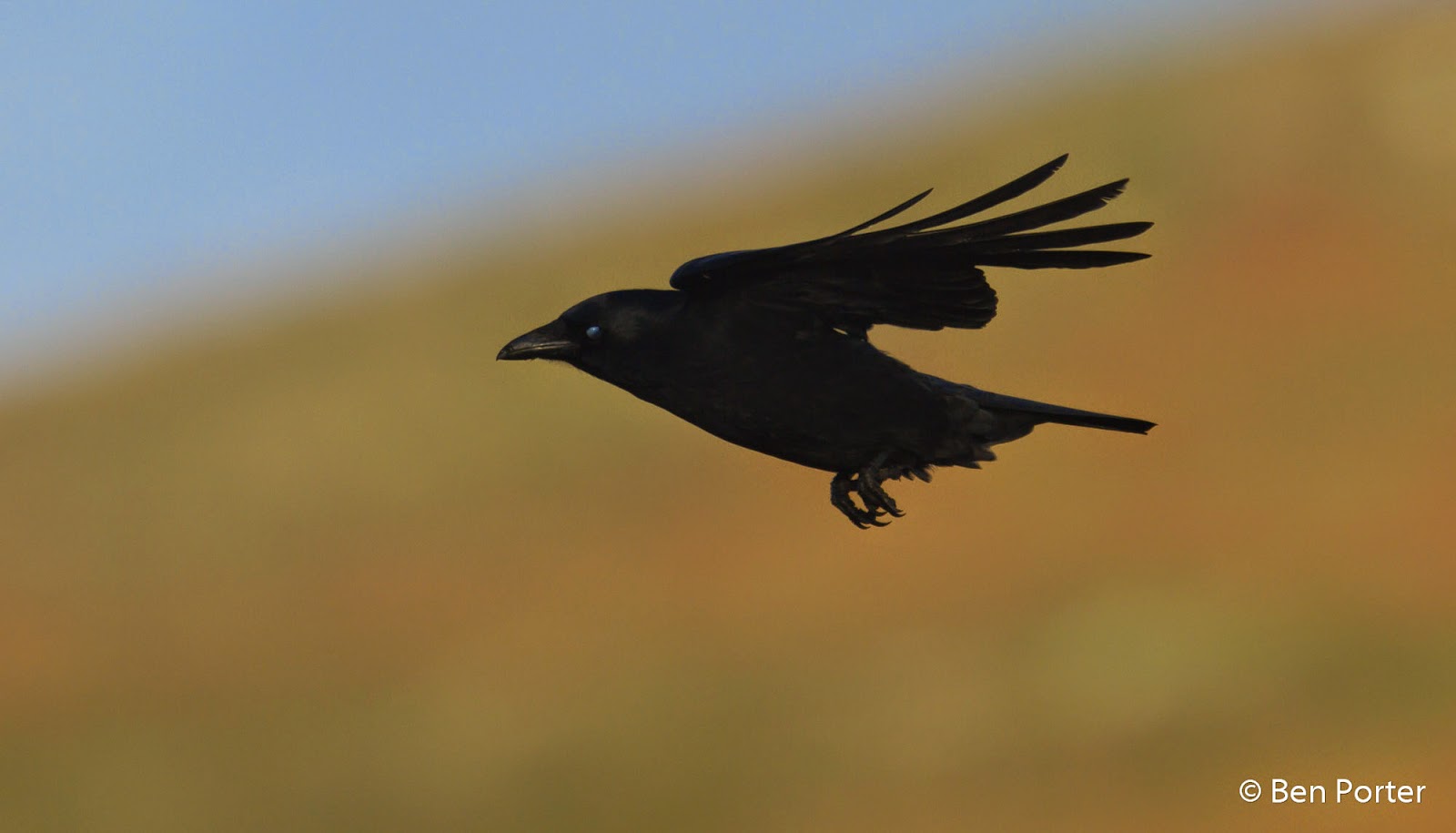
Well, first of all a very Happy Christmas from Bardsey Island! After what has felt like weeks of gloomy, overcast skies and stormy weather, the sun has finally made a break through in the last two days and allowed for some good photographic opportunities. I spent some of yesterday on Solfach, photographic the usual Choughs, Carrion Crows, Magpies, Rock Pipits and Hooded Crow feeding on the rotting seaweed. There were a lot of Guillemots moving out to sea (over 3000 yesterday), but unfortunately the seas had calmed down quite significantly, and so there were no interesting seascapes to photograph. Today has been very pleasant, and I managed to get some pleasing images of a juvenile Shag in Henllwyn.
![]() |
| Choughs continue to feed on insects in the rotting seaweed pile on Solfach |
![]() |
| Redshank |
![]() |
| This Hooded Crow has been present since the late autumn, and is the second consecutive winter on Bardsey that this species has decided to take up residence here |
![]() |
| Carrion Crows |
![]() |
| Magpie |
![]() |
| Turnstone |
![]() |
| Common Gull |
Subscribe to:
Posts (Atom)