Showing posts with label Gorse Shield Bug. Show all posts

Sunday, 15 November 2015

Hunting for winter inverts

Apologies for the poor upkeep of posts on my blog of late...for one it has been pretty grim weather for the last couple of weeks, which hasn't made it particularly conducive for either birding or photography, and also I am being kept fairly busy with the workload associated with undertaking a university degree! That said, there really is still plenty to look at and fin when you start looking...

I shall start with some moths. My faithful little heath trap has been doing ok just outside the caravan, but catches really have decreased fairly significantly recently. November (slash Autumnal) Moths have been perhaps the most common features, whilst Feathered Thorns have been turning up fairly regularly, which is great! Their bipectinate antenna, presumably from which the name originates, are superb! I have helped out with a couple of the moth-trapping events run on campus by the uni's environmental society 'Ecosoc', and a particular highlight was an Oak Nycteoline, which is a new one for me. Otherwise, the usual suspects such as Beaded Chestnuts, Large Yellow Underwings, Common Marbled Carpets and Black Rustics provide the rest of the entertainment...

Feathered Thorn - a truly superb species which has been a regular moth in the traps recently. This species has just one, relatively short generation, being on the wing from September to November

This smart moth is one of three confusingly similar species, that all occur at this time of year: the November Moth, the Pale November Moth and the Autumnal Moth. It can be very tricky to separate the three species on external characteristics alone, especially in the frequent melanistic individuals

This smart little moth could easily be taken for one of the angular micro moths in the Tortricidae family. It is an Oak Nycteoline. They are on the wing from October through to March, and come in a cool variety of different forms. I have no idea what justifies its name, but it is certainly amongst the more exotically-named lepidoptera species! All online dictionaries have thus far fallen short of defining the meaning of this intriguing name


...onto the other invertebrates then. Scavenging around campus and bush-bashing has revealed a surprising diversity of inverts clinging on despite the grim weather. One of the really cool things has been the discovery of the winter forms of Common Green Shieldbug. As their name suggests, they are for the most part an all-green shieldbug. However, as winter approaches and temperatures cool, individuals loose this green colour and fade into their dark brown form. This re-affirms their camouflage against the increasingly dulled tones associated with autumn and winter. It seems that they may also begin turning green again as temperatures warm in the spring. We have found many of these brown individuals around, and some in-between forms too!

There have also been plenty of other shieldbugs lurking around on plants around the campus- on Friday Will Hawkes and I managed to find three different species in one of the gardens, namely that of Gorse, Hairy and Common Green Shieldbugs. Will also managed to find one of these stunning little Cinnamon Bugs (Corizus hyoscyami). These bright little coleoptera species resemble the Fire Bugs that inhabit the nearby continent, and so it was cool to come across one in the garden. Butterflies and bees are all still very much on the wing, with plenty of fresh Red Admirals and Peacocks still out and about on still days, perhaps looking for somewhere to pitch up overwinter, such as a warm shed. The odd Bombus terrestris passes by still, and Honey Bees are still collecting pollen from the few flowering plants on campus! 

The smart Cinnamon Bug (Corizus hyoscyami). This is a species spreading northwards in the UK, with no records further than Liverpool as yet. It is most often encountered in the south, and is relatively common across Europe, having been recorded as far north as Finland! Its common name originates from the insect's apparent cinnamon fragrance if sniffed closely!

An interesting little beetle, with finely-indented elytra. This is the Cereal Leaf Beetle (Oulema rufocyanea), which can be a pest species on cereal crops

Just one example of the amazing difference between Common Green Shieldbugs at the moment! Very cool. Here are some more...

Common Green Shieldbugs

A Hairy Shieldbug

Gorse Shieldbug

Red Admiral

Saturday, 3 October 2015

A focus on the smaller side...

Over the last few weeks, it has been great to wander around the various wildlife-rich areas around Falmouth and spend a while looking at the smaller elements of nature...

Even when it is windy and dull, there is always something to look at, whether it be a bulky House Spider sheltering in a away in a hidden crevice, or perhaps a small Rove Beetle that scurries across the ground in front of you. Will Hawkes and I have had particular fun in finding a plethora of different Hoverfly and Shieldbug species lurking around the rich hedgerows and rank grassland patches nearby. We have almost encountered 10 species of the latter, whilst identifying the former is proving a little more tricky in some instances. It is great to find and observe the various forms of arthropods whilst the weather holds up and many are still actually around (not looking forward to the depths of winter!).

The spiders have been particularly entertaining, demonstrating a surprising diversity of prey items wrapped in neat packages within the webs of the Orb-weaving Spiders (Araneus diadematus). Anything from miniature midges to shieldbugs, grasshoppers, moths and even butterflies have been unfortunate enough to meet their end in these delicate structures- a few morning ago I had a great time photographing the stunning webs down at the Bissoe Valley with fellow photographer Max Thompson (see below).

Without waffling on too much, you can check out a bit of the invert diversity that we have encountered over the last week or two, and I shall try and give a bit of a caption for each :)


A couple of shots of the amazing webs of the Orb-weaving Spiders (mostly Araneus diadematus). A few mornings ago, I was at a nearby site in the Bissoe Valley and had the pleasure of photographing these stunning webs as the rising sun gave a delicate back-lighting and the light dew highlighted the strands

This little arachnid is a Zebra Jumping Spider (Salticus scenicus), a member of the Salticidae family. These species have incredibly adept eyesight, hunting primarily with the use of this sense. They move with a jerky motion over surfaces, 'hopping' or jumping using their hydraulically-powered legs

One of the many hoverfly species encountered recently- what appears to be Sericomyia silentis

A Knot-Grass Caterpillar, found in the garden on campus
Another caterpillar, this time a massive species that somehow turned up in a mist net at Nanjizal! An Eyed Hawkmoth

Some moth stuff...
I have been running my small heath trap fairly consistently outside the caravans for the last few weeks, but the catches have largely been quite low in both diversity and number. I think this is primarily due to the large moon, as last night saw over 20 moths in the trap, including some smart species like Beaded Chestnut, Autumnal Rustic, Feathered Ranunculus and Pink-barred Sallow. I am looking forward to a few more autumn moths in the coming week, especially with the use of a couple of moth traps on Uni campus grounds...
Green Carpets have been quite regular in the trap, and very welcome too!

A Copper Underwing of either of the two species- it looks to be Copper Underwing after examination of labial palps, underwings and forewing pattern, but I remain unconvinced that the two species (Svensson's Copper U vs. Copper U) can be identified on external features alone

Pink-barred Sallow- a classic autumnal moth

It has been great to see the odd Hummingbird Hawkmoth dotted around, especially this individual on campus a few days ago

Gorse Shieldbug (Piezodorus lituratus)


And now for a few 'macro'-centred images that I have taken over the last week or two (some are intentionally abstract...)

Oxeye Daisy at sunrise

Orb-weaving Spider's web 

A backlit Moss shot: Mnium hornum

Fungi of some sort- ink-caps?

Sycamore 'keys'

Fern reflections

Backlit ferns in the early morning light

Tuesday, 26 May 2015

Spring news

It has been a pleasant few weeks on the island, with a thoroughly mixed bag of weather conditions: most of the time these conditions have not at all been typical of mid-May! Strong winds with horizontal rain; chilly northerly breezes with clear skies and starry skyscapes; and then more recently calm winds, glorious sun and warm temperatures. The unsettled conditions has meant that generally the last few weeks have been very poor for migrant bird numbers on the island. Usually in May we have a few days when the island is covered in Sedge Warblers, Spotted Flycatchers and Whitethroats, but this year we have had much lower numbers- the highest day counts for these species has been 34, 25 and 25 respectively. We have had some good movements of hirundines, with over 1000 Swallows, 300 House Martins and 150 Sand Martins recorded on the 15th. A scattering of Whinchats, Yellow Wagtails, Common Redstarts, Tree Pipits and Reed Warblers has been the best of the rest.
Here are a handful of images from the last week or two:

Puffins are now incubating egss in their excavated burrows on the East Side. There have been around 40 individuals sat on the sea adjacent to the slopes on the last few visits, although there also appears to be a new colony on Pen Cristin this year
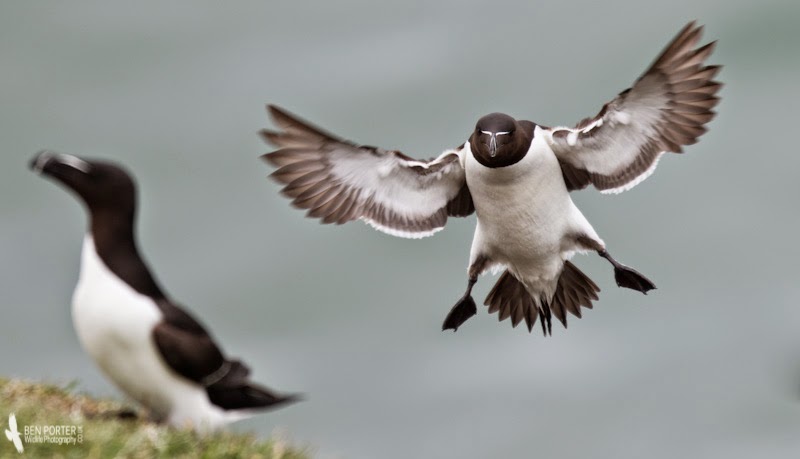
Razorbills are back in force on the island, with well over 1000 present on the rocky bouldery areas around the East Side. Many are on eggs, although we have not been able to see any chicks as yet


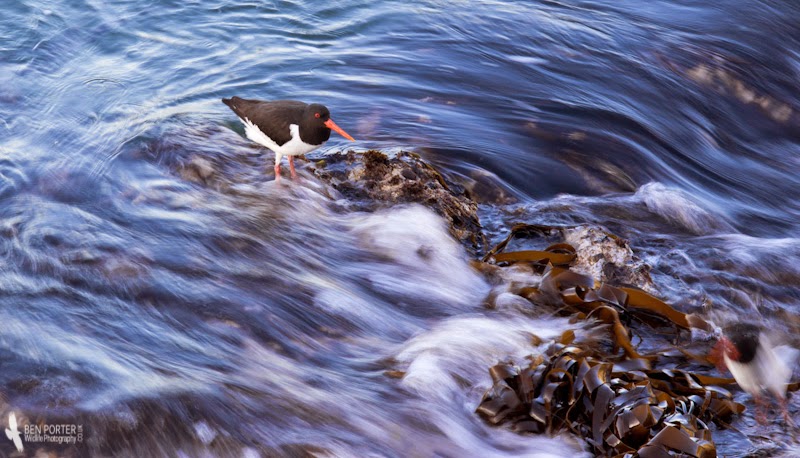
Oystercatchers are incubating too, although the first few nests with 'fledged' young have been recorded, so the birds will now get even more furious when people pass them by

Linnet taking a bath in a small puddle along the track

Green Tiger Beetle

Gorse Shield Bug

Garden Tiger caterpillar

Buff Tip