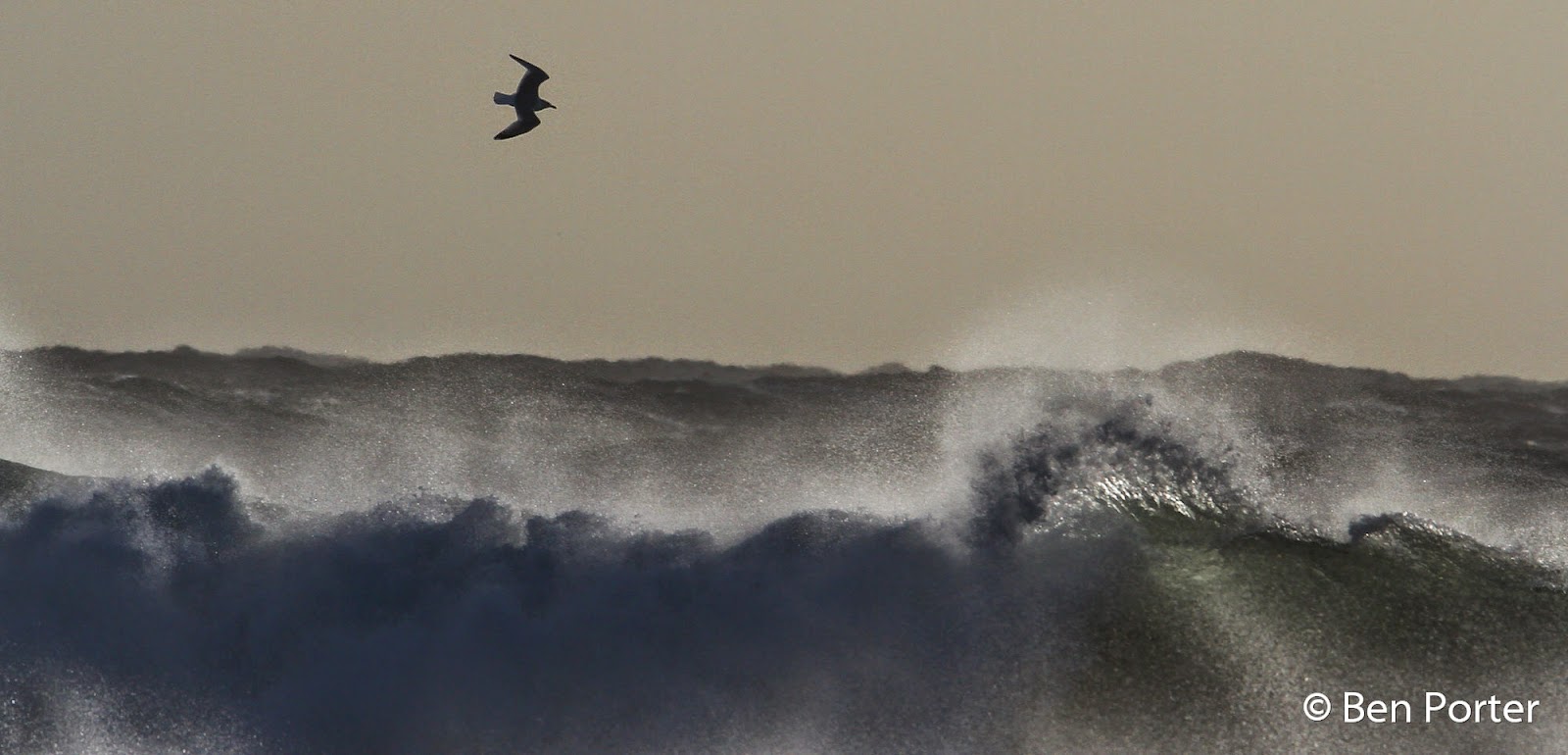
Since early December, the weather has taken a rather windy and dull deviation from the pleasant conditions we were experiencing in November. The last week has been incredibly dull and gloomy, and the constant strong winds have produced some large seas. Unfortunately the lighting has been appalling for photography, and so I have very few decent images of the recent storms that are any good. Here is a small selection from the 22nd.
Looking north-east from Solfach towards Bardsey Mountain. A very grey scene
The weather over the last two weeks has almost consistently been windy and overcast, which isn't terribly conducive for photography to say the least! However, the skies have cleared every now and then and allowed for some images to be taken. In terms of birding, it has been slow going: there have been two late Manx Shearwaters passing by out to sea this month, and a Great Skua on the 19th is also very late. A handful of Chiffchaffs have chosen to overwinter on Bardsey (the first time they have done so since 2007), but I'm sure some of them are regretting that now! Otherwise, the usual flock of up to 34 Choughs continues to feed on Solfach, whilst the Oystercatcher and Curlew flocks have been maxing out at about 60 each. A single Whimbrel has been hiding amongst the Curlews too.
Here is a short composite of videos taken on Bardsey Island this year. These were mostly taken with a Canon 7D and Canon 300mm F4 lens.
Some pictures from the week:
A Yellow Dung Fly in the morning light
A female Chaffinch feeding on some late winter berries
It is proving to be a very good winter for overwintering Stonechats, with at least seven pairs present. This is a smart male
One of the unfortunate Chiffchaffs which has decided to overwinter. Will the gamble pay off?
Winter on Bardsey is usually a pretty stormy affair- last winter was rather exceptional with the near-constant bombardment of storms throughout the winter, with some bringing winds of up to 108mph. This winter has, until the last week or two, been very mild, dry and quite calm. This has encouraged migrants such as Chiffchaffs and Blackcaps to risk overwintering. In the last few weeks, however, the weather has taken a turn for the worse, with strong winds and rain storms becoming more of the norm. Some of the pluses of the stormy weather include the interesting and sometimes dramatic photographic opportunities that it brings. Backlit waves, birds skimming over the tops of large rolling crashers, and high tides forcing waders such as Purple Sandpipers into unusual places. Here are a selection of images from the last week:
Last weekend I spent some time photographing the (essentially) resident Choughs on Solfach. The frsh Westerly breeze in combination with some warm winter sun made for some good photographic opportunities, as the Choughs glided down towards the beach and floated in the updraft created by the bank. The strong breeze did, however, mean that clouds moved over eastward in a constant stream, blocking the sun every few minutes. This made it a little frustrating to get the right lighting conditions, especially with a subject as dark as Choughs. Nevertheless, I did manage to obtain some pleasing result, which I have included below. All the images were taken with a Canon 7D and Canon 300mm f2.8, occasionally in combination with a 1.4x converter.
Chough taking a mid-flight scratch
Choughs in front of Cristin- Bardsey Bird and Field Observatory
Again, a Chough in front of Bardsey Bird and Field Observatory
This is a typical scene once the Choughs actually start feeding on the beach
Lastly, I have finally got round to producing a short video on the Choughs from a few weeks ago. This video was taken with a GoPro, which I positioned near one of the Chough's favourite feeding spots. I am quite pleased with some of the results
Over the last two weeks I have managed to get some reasonable images of the overwintering Purple Sandpipers on the island. They tend to only turn up in accessible places here when spring tides force them off their usual haunt (a rocky island 400m off the coast), and onto the rocks near Solfach. It makes for an entertaining watch as they cling onto rocks which are rapidly being claimed by the incoming tide. Unfortunately, the numbers of this charismatic sandpiper overwintering have decreased quite substantially in the last ten years. During my first few winters on the island, it was common to see flocks of 40-odd flying around and associating with as many as 60 Turnstones. And yet in the last few winters, numbers have barely reached 30. The maximum number I have seen so far this winter has been 16.
Over the last week or two I have taken a few macro images around the island, although generally I have been focussing on the Choughs and Starlings on Solfach. Here is a small selection of macro images, with no particular theme...
Oak Leaf with backlighting. Taken with Canon 7D and 300mm f2.8
Backlit moss, taken with Canon 7D and Sigma 105mm macro, plus extension tubes. I used a dark coat to mask the green grass of the background and replace it with something a bit more dramatic
A human eye in black and white. Canon 7D and Sigma 105mm macro
The mantle feathers of a Starling, taken with Canon 7D and Sigma 105mm macro
A Sycamore leaf 'skeleton'- just the veins of this leaf are left over after the rest has decomposed. Taken with Canon 7D and Sigma 105mm macro
Feather with dew droplets
Sycamore 'key'. Both of the above were taken with Canon 7D and Sigma 105mm macro