Tuesday, 8 December 2015

Photographic Advent Calendar, Day 7: Little Owls

Little Owls are brilliant birds...but many people might not realise that they do not actually belong in the UK. That is to say that they are an introduced species, and not part of our native fauna, just the same as Rabbits, Ring-necked Parakeets and Ruddy Ducks. However, there is something about their appearance; their cryptic and secretive nature, brown and mottled plumage, that lends themselves perfectly to the British landscape: they look and seem entirely at home here! Interestingly enough, this diurnal owl species has also been introduced to New Zealand, but its natural range is incredibly extensive: the population (taking in 13 different subspecies) traverses the Northern Hemisphere in a broad belt from Western Europe through to East Asia, whilst its northern and southern limits take in Latvia, Mongolia and Northern Africa respectively.

Anyway, onto the birds themselves...their Latin name (Athene noctua) is linked closely to greek legend: Pallas Athene was a greek goddess of wisdom and arts, and noctua was an owl sacred to the goddess Minerva. Perhaps these ancient links are where the phrase 'as wise as an owl' stems from? The diet of this diminutive species is pretty diverse: they will take anything from small birds and mammals, reptiles and amphibians, to a whole range of different invertebrate species. According to Avibase, up to 97% of Little Owl's diets in the Mediterranean is made up of invertebrates! There have been some amusing accounts of birds falling over backwards after an Earthworm snaps as it is being prized from ground! Some worries in recent years concerning this specie's diet is that they are actively hunting Storm Petrels at night on islands such as Skomer and Bardsey; what effect this is having in the petrel populations is yet to be revealed.

In terms of finding this species yourself, abandoned buildings, stone walls, fence posts and waste ground are all great places to spot these cool birds. On Bardsey, it is particularly common to come across birds perched out in the open at the bases of leggy, mature gorse bushes. Here are a few images taken on the island over the last few years:


Monday, 7 December 2015

Photographic Advent Calendar, Day 6: Green Tiger Beetle

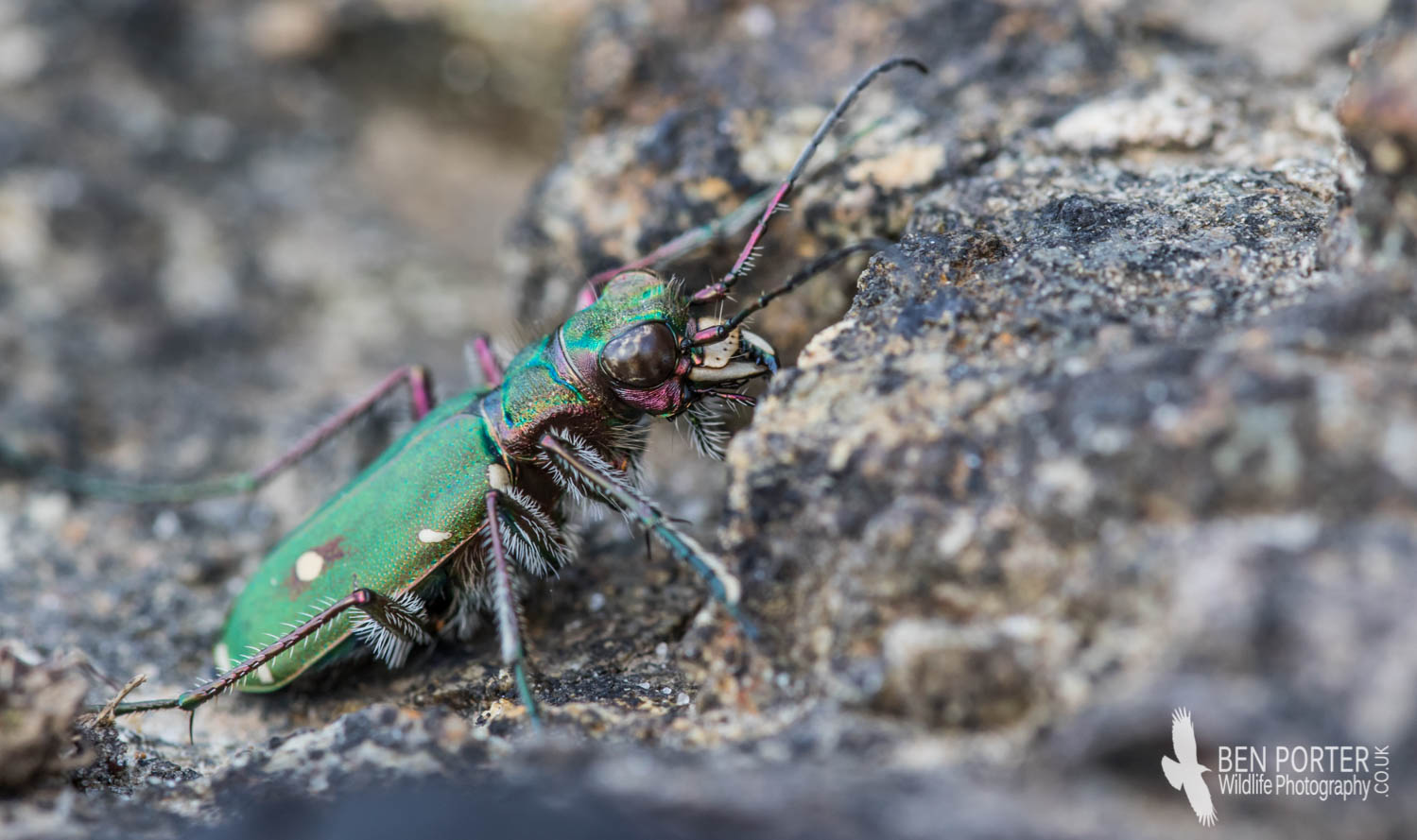
For today's wildlife feature in my photography advent calendar series, I will focus on the amazing beast that is the Green Tiger Beetle (Cincindela campestris). This feisty Coleoptera is a common ground beetle around various habitats in the UK, from heath and wasteland to coastal cliff edges and dry areas of soily ground. You can often encounter them on warm, sunny days in the spring and summertime, if you watch your feet carefully for when one skitters away or flies up abruptly when flushed.  They are amongst a large family of over 40, 000 species of ground beetles Worldwide, of which around 350 inhabit the UK.

These stunning beetles are not fussy eaters: they'll tackle anything from spiders and ants to caterpillars and other more sedentary prey items. Sporting an impressive pair of jaws (mandibles), they can break up their prey after pursuit at high speed on long, agile legs. The large eyes also help in spotting prey and evading predators and parasites such as Parasitic Wasps... and as any photographer who has tried to photograph these knows, their skittish nature does not help on the photography side of things! Another rather cool feature of this species is to do with the early stages of development: the larvae sport an impressive pair of mandibles too, which they use to consume prey items that fall into their burrows (essentially like a pitfall trap!).

So when you are next out for a walk in a sunny coastal spot or on a heathland, look out for these stunning predators- they are well worth a look!


Sunday, 6 December 2015

Photographic Advent Calendar, Day 5: Starlings

Starlings have to be one of my favourite winter birds, and why not? They congregate into sometimes gargantuan flocks that murmurate into the tens of thousands. This has to be one of the greatest winter birding spectacles across the UK, and can occur at any local reed bed near you, although locations such as Ham Wall in Somerset and Brighton pier are particularly impressive sites. Watching a huge flock of Starlings flow through the air and change shape, shade and tone in a split second is an amazing experience, which I have not had the pleasure of seeing for many years, living on Bardsey where a very small wintering population persists. This charismatic species is unfortunately currently on the Red List for its population declines in the UK. Changes to agriculture over the last few decades are one of the major causes, as with many 'common' garden and farmland birds in this country. Sturnus vulgaris (the latter merely meaning 'common') is therefore a key target for trying to protect, before these spectacular sights become a past occurrence. Check out a ringing recovery map for this species in Europe here, courtesy of the BTO.

I used a slow shutter speed to create the movement of feathers in this image as the bird shook

Part of a larger flock coming in to roost at Marazion marsh, a few weeks ago

I love watching Starlings feed: never content, always squabbling amongst themselves, they each have their own personality and are always up for a scrap

Part of a 100,000 roost of birds at Ham Wall, Somerset

Saturday, 5 December 2015

Photographic Advent Calendar, Day 4: Shield Bugs

Day four of my wildlife photographic advent calendar series...and for today's post I have chosen Shield Bugs (Hemiptera). These smart little invertebrates are named after their shield-like exoskeleton, which takes on various different forms in the variety of species found across the world. It is invariably five-sided (giving the family name of Pentatomids), and these species are often referred to as stink bugs, due to the pungent liquid emitted upon threat. In the UK, most species are herbivorous, feeding on plants and occasionally berries, whilst a few are even carnivorous! One of the cool characteristics of some species is to do with their developmental cycle: some show parental care, brooding eggs until they hatch, and then provisioning for their developing nymphs until a more advanced stage. This form of development is know as vivparious, contrasting to the holometabolous form adopted by other invertebrate species, where a larvae has to undergo complete metamorphosis to achieve the adult stage.

Will Hawkes and I have derived great enjoyment from discovering a wealth of different shield bug species present around the Cornwall area this autumn...we have recorded around 12 different species, including some very smart ones! There are still individuals hanging around, as we came across a Gorse and Common Green Shield Bugs just two days ago!

A collage showing some of the different Hemiptera species we have recorded this autumn

Gorse Shieldbug Piezodorus lituratus

Hairy Shieldbug Dolycoris baccarum

Dock Bug nymph Coreus marginatus

Common Green Shieldbugs Palomena prasina


Friday, 4 December 2015

Photographic Advent Calendar, Day 3: Grey Seals

Day three of the Wildlife Photography advent series leading up to Christmas features some slightly larger mammals than the previous two posts. I have decided to focus on Grey Seals in for this blog post...

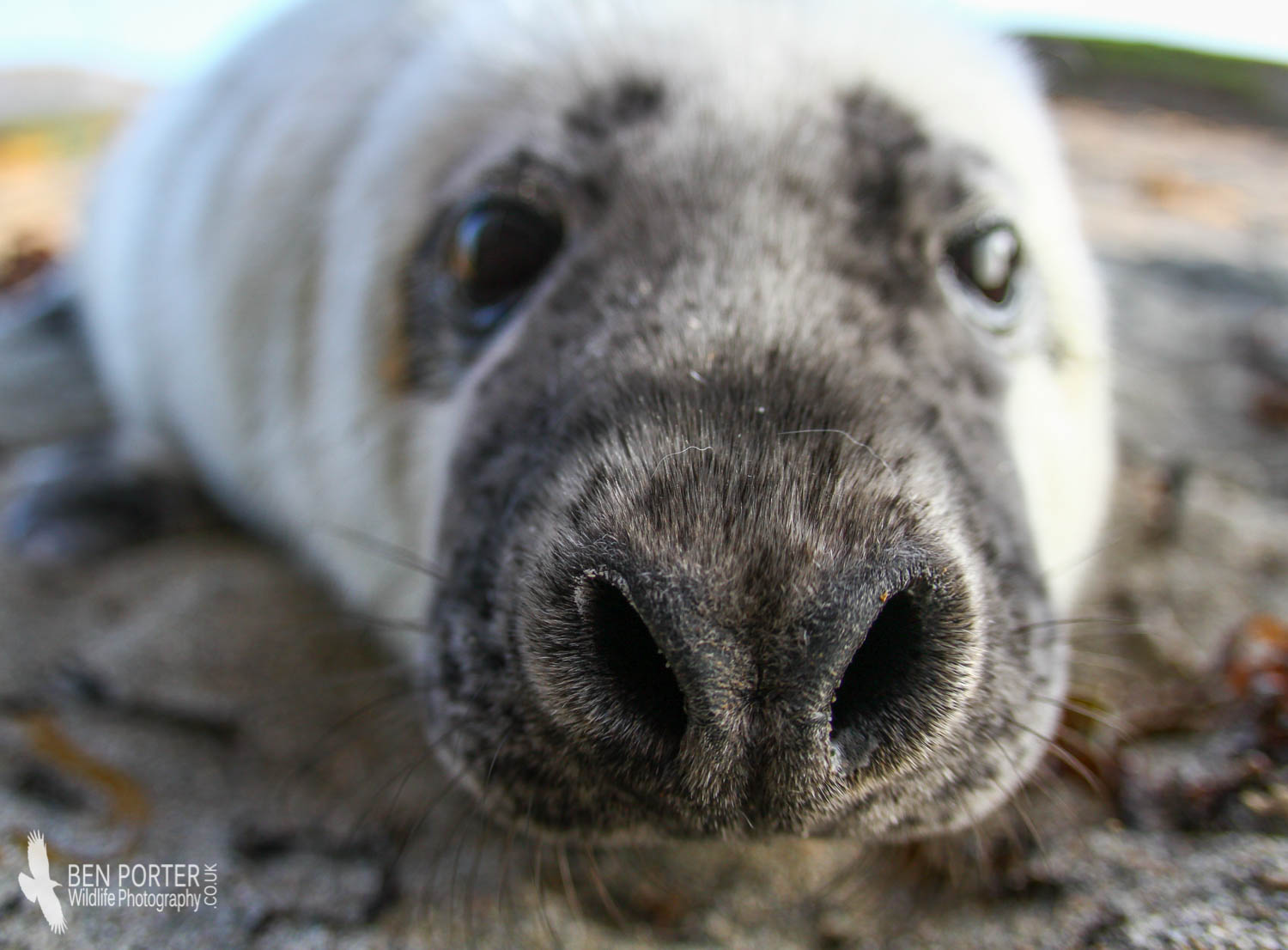
Grey Seals (Halichoerus grypus) are a species that is well distributed throughout the UK, where it occurs as the country's largest seal species: bulls can weigh up to 350kg, compared to just 200kg in female 'cows'. This is still substantially more bulky than the smaller, puppy-faced Common Seal, which occurs more on the east coast of the UK. It is estimated that over half the World's population of Grey Seals live in the waters surrounding the UK, where populations hover around 150,000 and over 90% of these occur in Scotland! Focussing back to the Lleyn Peninsula and Bardsey in particular, we tend to have a wintering population of around 150, and evidence suggests that there is frequent commuting between our population and that of the Wirral haul-outs, just up the coast.

Here are a handful of images of these superb animals, which are especially amazing when encountered below the surface of the sea...


Thursday, 3 December 2015

Photographic Advent Calendar, Day 2: Stonechats

Well, here is the second instalment of my photographic advent calendar series, being posted rather belatedly after another busy day! Today I have chosen to focus on another charismatic and smart avian species: the humble Stonechat. Saxicola torquatus (translating roughly to saxum-colere= 'to dwell near a rock' and torquis= 'a collar'), is a common sight across much of the UK, with the country holding roughly 60,000 pairs. Here in Cornwall i have been seeing a scattered few individuals in the scrubland and farmland around the coast, and many individuals have proven to be rather tame. The british Stonechats that decide to remain in situ all year around (and as opposed to flying down to warmer climes in Europe & Africa), tend to be quite susceptible to bouts of cold weather. Since they feed primarily on small invertebrates, prolonged cold periods can really have an effect on their populations. Back on Bardsey, the population dropped to around five/six pairs after the 2010 winter, from about an average of 10. Hopefully the climate will remain favourable for these smart little birds this winter...they can brighten up any dull, rainy day!


I shall endeavour to post something tomorrow, for day three of my advent photographic series...

Wednesday, 2 December 2015

Photography Advent Calendar, Day 1: Choughs

I have decided (somewhat belatedly), to try and do a sort of photographic advent calendar on my blog leading up to Christmas. I will attempt (time providing!) to post a handful of images every day, focussed on a particular wildlife species from around the UK (i.e. on Bardsey...)

For Day One of the challenge (which I am starting on the 2rd of December...) I have chosen the Chough. I have really missed not seeing these charismatic birds on a daily basis (ironically, despite being in Cornwall), and I look forward to catching up with Bardsey's wintering flock when I return in the next week or two. 
Choughs really are brilliant birds, and the winter is by far the best time to see them on the island, when a flock of up to 50 can descend upon Solfach (the main sandy beach), and feed upon invertebrates hiding away amongst the piles of rotting Kelp. It provides a great opportunity to observe these birds at close quarters and also pick out the colour combinations of colour-ringed individuals to work out who's come from where, who's partnered up with who, and who is just in the chilling in the bachelor & non-breeding flock. 
Here are a couple of images from the last to winters...