The Little Egret (Egretta garzetta) has a remarkable colonisation story in the UK, which has occurred rather rapidly over the last two decades. Although common throughout Europe and the Mediterranean, a range expansion into western and northern France in the latter half of the 20th century preceded its establishment as a breeding species in the UK in the late 1990s. Prior to this arrival, it was a very rare sight indeed around the southern coast of this country, attracting about as much attention as a Squacco Heron does at present. However, this range expansion (voiced to be a climate change-driven movement) led to its population explosion in the UK: the first successful breeding attempt was in Poole Harbour (Dorset) in 1996; ten years later there were 500 pairs in 60 colonies, followed by 800 pairs just two years later! You can see an impressive graph by the BTO documenting this colonisation here.
This species hasn't always had it easy: the elegant neck plumes sported by birds in breeding plumage were once sought out for ornamental decorations and fashion purposes, leading to significant population declines in the 19th Century. Indeed, the price for these plumes reached £15 for 28 grams, which is about £875 in today's prices! That made these plumes more valuable than gold for a time! Thankfully though, laws (and tastes in fashion) have since come in to put a halt to this pointless slaughter of such a beautiful bird. Nowadays, this elegant species can be found stalking the shallows in estuaries and coastlines around much of the UK, stabbing into rock pools and mud flats with its distinctive poised gait after invertebrates such as fish and crustaceans.
Monday, 21 December 2015
Sunday, 20 December 2015
Photographic Advent Calendar, Day 19: the Purple Sandpiper
For today's advent calendar blog post, I am focussing on a species which is perhaps a little more suiting to the current time of year...the Purple Sandpiper (Calidris maritima). This smart little wader is a favourite of mine, with a subtle plumage of gey tones with a delicate purplish tinge in the winter, accompanied with the bright yellow legs and base of the bill. They can be tricky to spot, remaining very well hidden at high tide in its preferred habitat type: dark rocks and boulders in the splash zone around exposed coasts and shorelines. Here on Bardsey, we have a small flock of wintering birds every year, although it has gradually been declining from around 50 birds in the 2000s to just 10-15 this winter. This trend fits with its status as an Amber species of conservation concern in the UK, due to recent declines in wintering and breeding population declines.
The Purple Sandpiper assumes a very interesting mating system in its breeding areas in the Arctic tundra: when paired, the Purple Sandpipers display a long-term bond with their partner, in a relationship known as monogamy. However, characters more typical of a polyandrous mating system have also been noted: it seems that the male takes on almost all the responsibility for the parental care of the hatchlings, with very little help from the female. They display the typical 'broken wing' tactic when threatened by predators, to lure attention away from a nest or young. The food source for this species varies depending on the time of year: in the summer, a range of terrestrial invertebrates such as spiders and insects will be taken, with more of a reliance upon marine gastropods and crustaceans in the winter months.
Saturday, 19 December 2015
Photographic Advent Calendar, Day 18: Six-spot Burnet
The Six-spot Burnet moth (Zygaena filipendulae) is a classic summertime day-flyer, frequently encountered in grassy landscapes and open scrub habitats. They are amongst several similar-looking species in the burnet and forester family, although are the only member to exhibit six red dots on each forewing. That said, some individuals may have fused spots to confuse matters, and some forms can have yellow spots (a subspecies called Z. f. flava), with brown spots noted in a few rare cases! The life cycle of this moth involves Bird's Foot Trefoil as the primary foodplant. The eggs are laid on this low-growing species, where the caterpillars hatch out and spend at least one winter (sometimes two) before they reach full size; they grow in a series of moults called 'instar' stages, where the outer cuticle (the exoskeleton) is shed to allow room for expansion before the next cuticle hardens. After the last instar moult, the caterpillar will find a stout blade of grass or fence post on which to pupate, spinning a silken encasement in which it undergoes its radical transformation. After a week or two, the adult moth bursts out of this silken tube, pumping hemolymph and other fluids into their delicate, crumpled wings. The striking black-and-red patterning of the adult moth is an example of aposematic colouration, warning would-be predators that they really aren't that tasty to consume!
A Six-spot Burnet feeding on some Bird's Foot Trefoil with Bardsey Bird and Field Observatory in the background. A sunny summer's day!
A late instar caterpillar half way through constructing its cacoon...the whole process took just an hour or so!
A few weeks later, and this handsome adult moth hatches out, after undergoing a radical change during complete metamorphosis
One of the unlucky ones, getting tangled up in an Orb-weaving Spider's trap
Friday, 18 December 2015
Photographic Advent Calendar, Day 17: the Sparrowhawk
The Sparrowhawk has to be one of the UK's most familiar raptors, regularly appearing in gardens to take a quick pop at songbirds feeding on garden feeders. They are apex predators, with the ultimate edge combination of speed, agility, lethal talons and sharp eyesight. They use this combination to launch surprise attacks on unsuspecting songbirds in woodland habitats, keeping a low profile and using stealthy tactics to dash out at their prey. Like most species of raptors, Sparrowhawks exhibit sexual dimorphism, with the female being significantly larger than males: typical weights are around 150g in males and 300g in a females. This difference in size provides a number of advantages, for : example enabling a greater size range of prey to be utilised in any giver territory. During the breeding season, when the female spends a good month or so incubating the eggs, the male's smaller size is better suited to weaving in and out of foliage and trees to secure a regular supply of small passerines to feed the female. However, the female is able to take down larger prey once released from incubation, providing a more wholesome meal for developing chicks.
Sparrowhawks are extremely well distributed across the northern hemisphere, occurring in a broad band from western Europe through to east Asia. This range (see a map here) takes in a total of six different subspecies, although the European Sparrowhawk is the predominant form in this area of the globe; some interesting subspecies are restricted to islands such as Sardinia and Corsica in the mediterranean, and the Canary and Madeira islands in the north Atlantic. Although a common sight across the UK now, this species was amongst several birds of prey that suffered from the effects of heavy pesticide use in the early 1900s. The thinning of egg shells - amongst other factors - caused a significant population decline that resulted in their disappearance from many areas in the country (like eastern England). Thankfully the responsible pesticides were banned in the 1960s, leading to a steady recovery to a population of around 32, 000 at current.
I was lucky enough to witness this dramatic struggle between a female Sparrowhawk and Magpie a couple of years ago, which lasted a good 40 minutes. Ultimately the magpie met its fate, but it didn't leave without a good fight!
Sparrowhawks are extremely well distributed across the northern hemisphere, occurring in a broad band from western Europe through to east Asia. This range (see a map here) takes in a total of six different subspecies, although the European Sparrowhawk is the predominant form in this area of the globe; some interesting subspecies are restricted to islands such as Sardinia and Corsica in the mediterranean, and the Canary and Madeira islands in the north Atlantic. Although a common sight across the UK now, this species was amongst several birds of prey that suffered from the effects of heavy pesticide use in the early 1900s. The thinning of egg shells - amongst other factors - caused a significant population decline that resulted in their disappearance from many areas in the country (like eastern England). Thankfully the responsible pesticides were banned in the 1960s, leading to a steady recovery to a population of around 32, 000 at current.
Thursday, 17 December 2015
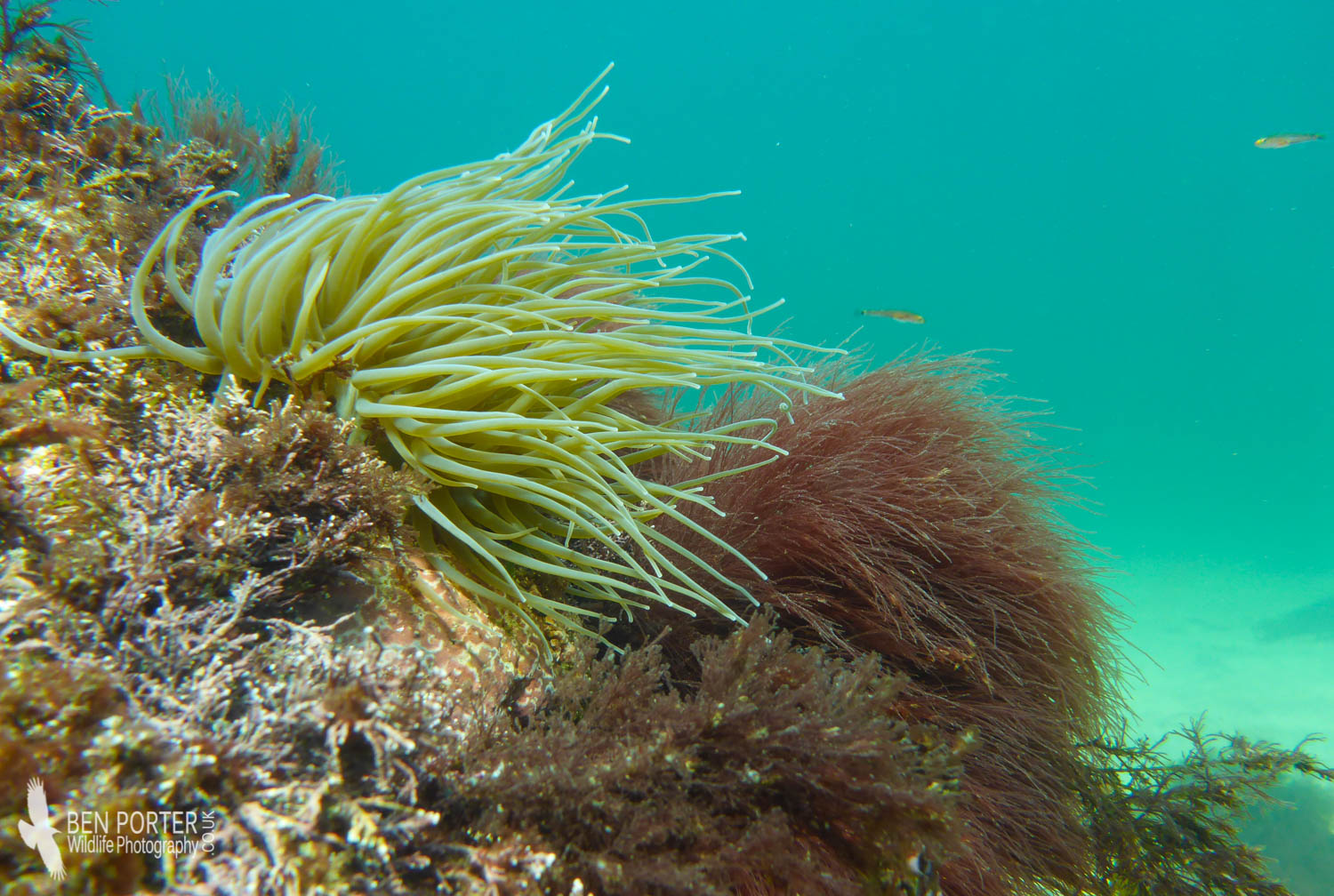
Photographic Advent Calendar, Day 16: Snakelocks Anemone
For my 16th advent calendar post, I am focussing on something a bit different...the Snakelocks Anemone (Anemonia viridis). This anemone species is distributed throughout the UK's coastal waters, and occurs as far south as the Mediterranean. Anemones such as the Snakelocks are a member of the class Anthozoa, within the clade Cnidaria. Cnidarians include jellyfish and other familiar animals, most of which have the ability to sting their prey using specialised cells called nematocysts. These nematocysts, or cnidocytes, contain a coiled organelle much like a coiled spring; when triggered, this structure uncoils rapidly and penetrates the skin of the prey, like a mini hypodermic needle. The toxin is then inject within milliseconds of impact.
The cool thing about the Snakelocks Anemone is that, in shallow waters and rock pools that are well-illuminated, they assume a symbiotic relationship with an algae called Zooxanthellae. The algae are able to photosynthesise, converting sunlight into energy which benefits the anemone. The algae give the purple tips that are common in many of the anemones, and the tentacles take up a bright green colouration due to a green fluorescent protein. However, where sunlight is less penetrating in the deeper coastal waters, the anemones do not utilise the algae and are thus a duller grey colour; this seems to be the typical appearance of most of the ones I have seen whilst snorkelling around Bardsey.
Wednesday, 16 December 2015
Photographic Advent Calendar, Day 15: Painted Lady
The Painted Lady (Vanessa cardui) is a smart lepidoptera species that is highly migratory, and can often form large influxes involving tens of thousands of individuals. Every year this species repeats its migratory cycle, starting off in the northern reaches of Africa and the Middle East, moving north through Europe and arriving in the UK as early as March. These first migrants will lay their eggs, giving rise to a second generation around August time; occasionally there may be more than one brood in the UK, depending on the weather. Some of these second generation butterflies can make it as far as the Orkney and Shetland Isles. Indeed, the Painted Lady is said to be the only butterfly species ever recorded on Iceland.
Ultimately, the fate of most of these migrants is that of premature death, as the winter conditions in this country are too harsh for the Painted Lady to overwinter in any part of the life cycle. Some individuals are thought to attempt the autumn migration back south, but it isn't entirely clear what proportion make this move.
Thistles, Mallows and Common Nettle make up the bulk of the larvae's foodplants, although adults will feed on any high-nectar source to fuel their continual movement. The last large influx of Painted Ladies was in 2009, when even on Bardsey I can remember counting hundreds streaming through every hour- an amazing sight. 2015 has been a good year too, with particularly high numbers feeding on the coastal thrift in June.
Ultimately, the fate of most of these migrants is that of premature death, as the winter conditions in this country are too harsh for the Painted Lady to overwinter in any part of the life cycle. Some individuals are thought to attempt the autumn migration back south, but it isn't entirely clear what proportion make this move.
Thistles, Mallows and Common Nettle make up the bulk of the larvae's foodplants, although adults will feed on any high-nectar source to fuel their continual movement. The last large influx of Painted Ladies was in 2009, when even on Bardsey I can remember counting hundreds streaming through every hour- an amazing sight. 2015 has been a good year too, with particularly high numbers feeding on the coastal thrift in June.
Tuesday, 15 December 2015
Photographic Advent Calendar, Day 14: Oystercatcher
This has to be one of those birds that truly epitomises the coast: no stretch of shoreline is complete without at least a few pairs of feisty Oystercatchers dive-bombing intruders and issuing their piercing calls with persistent vigour. Although they can get a little vexing after a whole spring of harassment, they really are smart birds. We have around 60 pairs here on Bardsey, with a wintering population of between 60 and 100. Across the UK, there are around 110, 000 breeding pairs; despite this, recent population declines have placed it on the amber list, and it is listed more widely on the European red list.
Anyway, onto the birds themselves...they have some rather cool adaptations to suit their lifestyle of feeding on bivalve molluscs such as mussels and cockles. The species can deploy one of two techniques for tackling these tricky meals, and these techniques are passed from parent to offspring. The first technique involves hammering through the side of the shell, creating a hole through which they can extract the organism within; the second relies on the use of the flat bill to prize open the two sides of the bivalve, before severing the adductor muscles and taking the reward. These fascinating aspects of behaviour have also influenced the morphology of the birds, encouraging shorter, stouter bills with the 'hammering' technique, and longer, thinner bills with the 'stabbing' one. Due to this specialised form of feeding, juvenile birds have been observed associating with their parents up to a year after hatching!
One more cool fact...the scientific name for this species (Haemotopus ostralegus) can be translated roughly to 'blood-foot' (haima + pous) and 'to lift oysters' (ostrea is an oyster, and legere is 'to lift'). Very descriptive! They also used to go by the old name of 'sea pie'.
If you would like to see more of my Oystercatcher images, you can check out the gallery on my website here
Anyway, onto the birds themselves...they have some rather cool adaptations to suit their lifestyle of feeding on bivalve molluscs such as mussels and cockles. The species can deploy one of two techniques for tackling these tricky meals, and these techniques are passed from parent to offspring. The first technique involves hammering through the side of the shell, creating a hole through which they can extract the organism within; the second relies on the use of the flat bill to prize open the two sides of the bivalve, before severing the adductor muscles and taking the reward. These fascinating aspects of behaviour have also influenced the morphology of the birds, encouraging shorter, stouter bills with the 'hammering' technique, and longer, thinner bills with the 'stabbing' one. Due to this specialised form of feeding, juvenile birds have been observed associating with their parents up to a year after hatching!
One more cool fact...the scientific name for this species (Haemotopus ostralegus) can be translated roughly to 'blood-foot' (haima + pous) and 'to lift oysters' (ostrea is an oyster, and legere is 'to lift'). Very descriptive! They also used to go by the old name of 'sea pie'.
If you would like to see more of my Oystercatcher images, you can check out the gallery on my website here
Subscribe to:
Posts (Atom)