Monday, 1 June 2015

May moths and macro shots

Despite the ridiculously unsettled conditions that we are currently experiencing, a few of the smaller inhabitants of the island are just about managing to emerge. It is a very slow spring in terms of moths, with numbers in the moth traps barely struggling into the double figure mark. There are plenty of caterpillars around, such as Six-spot Burnets, Lackeys, Garden Tigers, a Grayling and Yellowtails. I have spent a bit of time taking macro shots of a few insects which I have come across, mainly because it has been very dull on the bird front! It has pretty hard to believe that we are now in June, especially considering that a 45mph wind is currently howling through, accompanied by horizontal rain and temperatures of 4'C with wind chill! Here is a selection of images from the last week or two:


This rather stunning insect is a Ruby-tailed Wasp (Chrysis ignita). It is a species of Cuckoo Wasp, and thus lays its eggs in the nests of other wasp species. The iridescent armour that this species possesses enables it to withstand the strong mandibles and stings employed by other wasp species in defence of the infiltration of a wasp nest. I found at least five individuals around the back of our house yesterday, basking in the (pre-storm) sunshine

This is perhaps my best macro shot yet of the Green Tiger Beetle, although the depth of field could be improved. There are still a few of these beetles stomping around the coast, although generally there seem to be fewer than a few weeks ago. The small holes in earth banks are, however, very obvious- this is where the larvae have their (effectively) pitfall traps

A Scalloped Hazel, amongst a total of three trapped so far this year

Common Marbled Carpets are just emerging

Lackey (moth) caterpillars are pretty cool. Aside their wild hairstyle, this species forms silk 'tents' in its earlier instar stages. Tens of caterpillars hatch out from a clump of eggs, and spin what is known as a tent. This tent contains many different chambers, which are layered from the inside out. Because of the silk's insulating properties, the inside of the tent can be 30'C higher than the outside temperature!! This heat is used primarily during the caterpillar's earliest instar stages, before they become big enough to withstand colder temperatures, at which point they leave the tent and forage on surrounding vegetation independently. 


Garden Tiger caterpillar

Saturday, 30 May 2015

Shore Lark!

After a rather frustrating spring for scarce and rare birds on the island (generally involving very brief views of something before it disappears), we finally got a stunning bird today: this male Shore Lark. Found by Steffan in the north-west fields in the morning, this smart lark spent the rest of the day feeding amongst the clods of dry earth and emerging seedling. It is very much an unseasonal occurrence in the UK, with sightings more typically spread from late October to March. The last sighting of one in the UK this year was at Cleveland on the 4th of May. Most birds should be in the high Arctic by now! The last record on Bardsey was in November 1997- almost 20 years ago! It just shows what a rare bird it is here, and indeed its status in Wales results in it appearing on the Welsh Descriptions list. The scientific name of this species is Eremophila alpestris. This translate to 'desert-loving' and 'of the alps' (emeros = Desert + philos= loving, alpestric= of the alps). There are a whopping 42 different subspecies of the lark Worldwide. You can find out more about the species on the BTO website and on the Cornell Lab's site.

Shore Lark. Canon 7D mkII, Canon 300mm f4, Canon 1,4x converter

Tuesday, 26 May 2015

Spring news

It has been a pleasant few weeks on the island, with a thoroughly mixed bag of weather conditions: most of the time these conditions have not at all been typical of mid-May! Strong winds with horizontal rain; chilly northerly breezes with clear skies and starry skyscapes; and then more recently calm winds, glorious sun and warm temperatures. The unsettled conditions has meant that generally the last few weeks have been very poor for migrant bird numbers on the island. Usually in May we have a few days when the island is covered in Sedge Warblers, Spotted Flycatchers and Whitethroats, but this year we have had much lower numbers- the highest day counts for these species has been 34, 25 and 25 respectively. We have had some good movements of hirundines, with over 1000 Swallows, 300 House Martins and 150 Sand Martins recorded on the 15th. A scattering of Whinchats, Yellow Wagtails, Common Redstarts, Tree Pipits and Reed Warblers has been the best of the rest.
Here are a handful of images from the last week or two:

Puffins are now incubating egss in their excavated burrows on the East Side. There have been around 40 individuals sat on the sea adjacent to the slopes on the last few visits, although there also appears to be a new colony on Pen Cristin this year
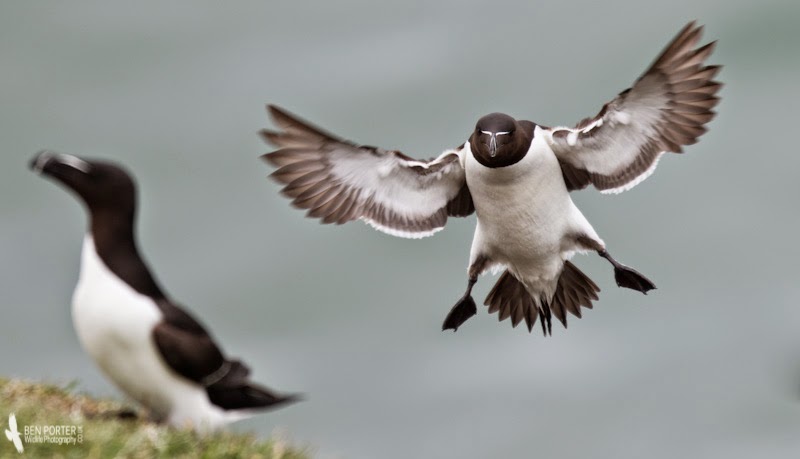
Razorbills are back in force on the island, with well over 1000 present on the rocky bouldery areas around the East Side. Many are on eggs, although we have not been able to see any chicks as yet


Oystercatchers are incubating too, although the first few nests with 'fledged' young have been recorded, so the birds will now get even more furious when people pass them by

Linnet taking a bath in a small puddle along the track

Green Tiger Beetle

Gorse Shield Bug

Garden Tiger caterpillar

Buff Tip 

Monday, 25 May 2015

New website

I have just finished creating a new photographic website, which can be seen by following the link: www.benporterwildlife.co.uk. Although my previous website was adequate, I had quite a few niggling issues and the display of image quality was not particularly good, and so I decided to go with smugmug. This has been relatively easy, and in the process of designing a new website I have added lots of new content, introducing a Grey Seal gallery and also a Black and white photography gallery. Feel free to take a look and point out any mistakes or improvements. Thanks!

Homepage

Gallery page

Thursday, 21 May 2015

Oystercatchers

No stretch of coastline around the UK is complete without at least a few pairs of Oystercatchers. Bardsey is home to about 80 pairs, which breed around the entire coastline year after year. From mid-Spring to late Summer it is rather hard to go for a walk anywhere near the sea without setting a pair up into the air with their loud piercing alarm calls, and with the ferocious attacks in some situations. They are, despite becoming rather annoying as the year progresses, pretty charasmatic birds that are certainly on of the most obvious things that pop into mind when you think of the coast. (well, certainly for me, at any rate).

At the moment, all of the pairs around the island are incubating eggs, which are laid in a small scrape on a rocky ledge or shingle beach. Both the males and females can share incubating duties, although most often it is the female. The period of incubation is between 24 and 27 days, whereafter it can often take another few weeks before the chicks fledge. The young are said to be precocial, which just means that they hatch out at a fairly advanced stage of development, leaving the nest very soon after hatching, find their own food, and follow their parents.

An interesting fact about Oystercatcher chicks is that, due to the species' very specialised feeding habit, the young will often remain with the parents for weeks so that they may learn the techniques involved in extracting bivalves from their tough shells. It has even been said that the young may associate with their parents for up to a year after fledging.

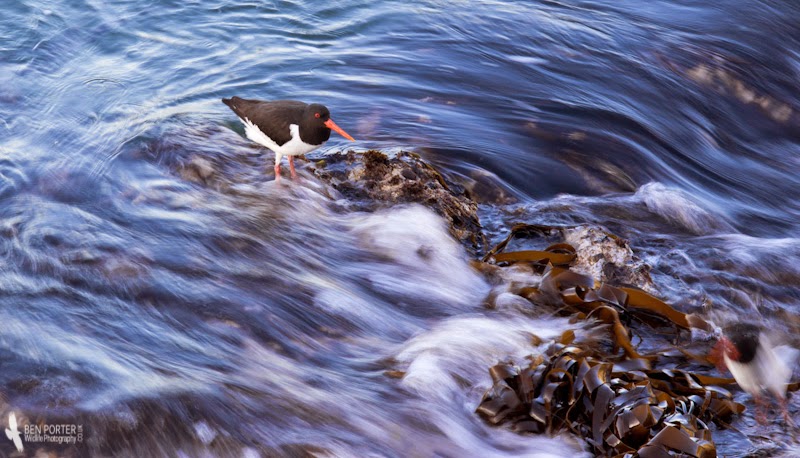
I have made a bit more of an effort to photograph this species in its element this year, with a mixture of long exposures and finding the right locations for atmospheric shots. Here is a selection of images from the last week, taken with Canon 7Dmk II and Canon 300mm f2.8 + 1.4x converter.

A few nights ago I was out in the evening when a very heavy rain storm arrived. Instead of running back to the house or nearest shelter, I took the opportunity to try and get some more atmospheric images of a few Oystercatchers which were perched on some rocks not far away. With a strong wind, the rain was almost horizontal, and got very heavy indeed. Sheltering behind my camera bag, I was really pleased when the sun dropped below the rain cloud on the western side of me, and so backlit the rain in a really nice way. I experimented using different shutter speeds to get the most desirable effect on the rain

There are around 80 pairs of Oystercatchers nesting on Bardsey, and they are all incubating eggs at the moment. I used a remote shutter release and fisheye lens to capture this bird on a nest on Solfach. This bird is relatively tolerant of human presence on the beach, due to the number of visitors that visit

For this image I used a slow shutter speed of 25th second to capture the slightly backlit waves crashing on the rock. This type of image is one that I have really been experimenting with this year

A somewhat perturbed Oystercatcher reacting to me being a bit too close to their hidden nest

A couple more

Sunday, 17 May 2015

Spring invertebrates

This post is focussed on some of the smaller inhabitants of the island. Spring is a great time of year to see the emergence of a range of insects and reptiles. This year. however, has been a little poor due to the unsettled weather conditions. There are still plenty of things to look at though! 


This handsome beast is a Green Tiger Beetle (Cicindela campestris), and is present around the coast of Bardsey on calm, sunny afternoon. In terms of a UK status, this species is the commonest tiger beetle. They are excellent predators, with running fast at times on their long legs, and making short buzzing flights when disturbed. The larvae develop in small burrows in the earth, which also act as pitfall traps, thus catching unwary prey which happen to fall in

This (not so handsome) insect is a Yellow Dung Fly (Scathophaga stercoraria). It is perhaps one of the most abundant flies in many parts of the UK (and Northern Hemisphere for that matter). The adults hang around fresh faeces, where they breed and lay their eggs within the organic matter on the dung. The adult flies feed on small insects 

Green-veined White. This species is by far the commonest butterfly on Bardsey, and they are beginning to emerge in small numbers on warm days

Moths
This year has generally been very poor for moths, largely due to the unsettled and mostly quite chilly conditions. Moth-trapping has been met with mixed success: often yields have been just one or two, with Hebrew Characters and Flame Shoulders featuring most commonly at the moment. I have trapped a couple of new species for Bardsey in recent weeks, namely a Shoulder Stripe (geometrid) and a Water Carpet (common species in the UK). Marbled Coronets, Common Quakers, Early Thorns and Double-striped Pugs are among the commonest species at the moment

Marbled Coronet

Early Thorn

Early Grey

Shoulder Stripe

Monday, 11 May 2015

Spring soldiers on

Well! It is hard to believe that it is almost mid-May, what with the recent chilly temperatures, almost constant strong winds and frequent rain storms. The conditions are more typical of mid-winter, but the wildlife continues to soldier on, and you do not have to look far before seeing the signs that Spring is in fact in full swing: the Mountain's East Side is now a carpet of pink Thrift, which contrasts with the west side of the Mountain, which is a vivid yellow from the Gorse; Oystercatcher pairs all around the coast are now incubating eggs in their small scrapes, whilst hundreds of seabirds on the cliffs are well into breeding, with some Shag pairs already rearing their ugly chicks. The vegetation around the island is shooting up after the recent rain showers, despite the wind and temperatures, although the same can not be said for the island's lepidoptera: the low temperatures have severely affected catch numbers in the moth traps, with the highest catches being no more than 10 individuals of five species. Green-veined Whites are beginning to increase in numbers, and the first Painted Lady of the year put in an appearance today. I have taken plenty of images over the last week or so, although the weather has restricted certain things...here is a selection of some of my favourites:

 This image is the first of a new project that I am beginning along the line of macro photography: using a fisheye lens to bring in a bit more of the environment, whilst still retaining interest in the main subject. This Honey Bee was feeding on the coastal Thrift on the East Side, and I used a Canon 7D mkII and Canon fisheye 15mm lens to get very close to the insect, but try and capture a bit of the background and foreground. There are plenty of niggling things wrong with the image, such as the awkward composition, although I am pleased with it as a start

Whilst carrying out a morning ringing session at the northern end of the island, this male Sparrowhawk flew into one of the mist nets. It was a rather pleasant surprise, and after extracting it, I took to the observatory for the ringing procedure. This image was taken with a Sigma 105mm f2.8 macro lens just prior to release

The last week has been excellent for Cuckoos, with tree present on one day a few days ago. Two male birds feeding along a fence line at Nant presented a good photographic opportunity, so I set up my small hide and managed to grab the lower image before a huge rain storm set in for the rest of the day. The first two images were taken the next day, when a female bird present in the Withies proved to be quite an approachable bird


Shellducks in the rain- taken on a rather grim day, with lashing rain, very strong south-westerly winds and a high tide. The combination of conditions did, however, make for some interesting angles and images, with the bird coming very close to the hide on Solfach

Some pairs of Stonechats have already fledged their first broods of young, and are now busy trying to find enough food to stuff down the bright gapes of the chicks

A flight shot of a Razorbill from yesterday. There are many hundreds in the rocky boulder fields and cliff areas around the East Side now, many of which are likely to be on eggs