Wednesday, 16 September 2015

Freshers Week - Invertebrate life

It has been superb to wander around hedgerows and areas of scrub grassland and discovery a plethora of interesting bugs, flies, moths, spiders beetles and various other invertebrates! (a typical Freshers week activity...). Will Hawkes and I (Will is a great photographer and naturalist from Llangollen, who is studying a similar course to me) have managed to crack down on a really cool variety of species, with the help of my sister and also Ellie Mahew.  Although the insect life back home on Bardsey is good at times, it is certainly very limited in its diversity, so coming to the mainland and seeing so many different species is really cool! It has been great fun learning about them and trying to track down the various IDs...I have uploaded a few images below which give a good selection of our discoveries...


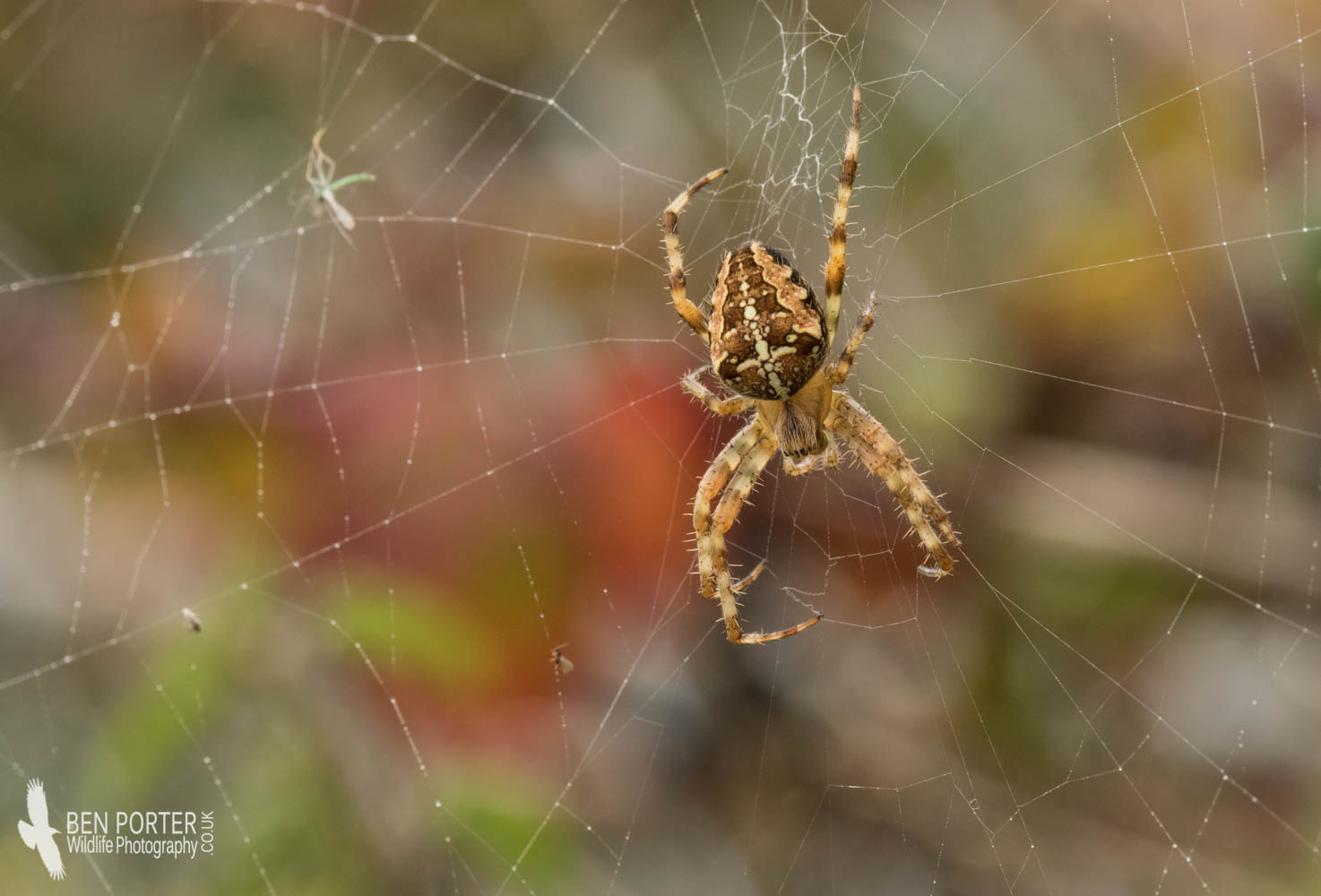
 This has been one of the biggest highlights for me...a (very small) male Wasp Spider! I have always wanted to see one of these striking and beautiful arachnids, and really didn't expect to see one today as we were walking along the coastal path to Maenporth- well done Rachel! The females of this species are much larger than males, having swollen abdomens of lengths over 1cm with the stunning black, white and yellow stripes as in this one

 There seem to be an awful lot of Orb-weaving Spiders around, with hundreds of individuals lining all of the lanes and scrub hedgerows, varying enormously in size and colouration. Most of them appear to Garden Spiders (Araneus diadematus). We have seen a large variety of prey items strung out in their perfect orb webs, including Grasshoppers, Parasitic Wasps, small micro moths and many different fly species


One of the equally most numerous families seemingly plastered along every bramble hedgerow is that of the Shieldbugs: Hemiptera. The Common Green Shield-bug seems to be the most common at the moment, but there have also been large numbers of the Dock Bug on its foodplant too...
Hairy Shield Bug (Dolycoris baccarum)

 Both of the above are Dock Bugs (Coreus marginatus), but the lower individual is a late instar, showing a different colour and shape to the adult on top

Common Green Shield-bug (Palomena prasina)

Red-legged Shield-bug (Pentatoma rufipes)

Speckled Woods have been nice to see too, as we rarely get this shy woodland-dwelling butterflies over onto the island

 Field Grasshopper (Chorthippus brunneus)

Meadow Grasshopper (Chorthippus parallelus)

This cool caterpillar was hiding in the bracken alongside the path today, doing its best to blend in- and it did that rather well! This one will become a Dot Moth after pupating

One of the smaller things we've found, and what initially looked like a mini Devil's Coach-horse Beetle; it is a Rove Beetle (Paederus littoralis), 

Monday, 14 September 2015

Falmouth - my new home!

Well, it is official! I have actually left Bardsey Island, and for a fairly long stretch of time at that!! I have travelled down to Falmouth with courtesy of my Mum, and will beginning a three-year course on Conservation and Ecology with Exeter University here at Penrhyn, in the heart of Cornwall. Although leaving the island is hard, I am sure it will be an enjoyable experience, with many opportunities for birding, photography, exciting wildlife and new friends!

A parting shot from the isle...a 30 second exposure during which I tried to spell my name with a headtorch (it sort of worked...)

After arriving on Saturday after a fairly long drive down, it has been fun settling into my term-time accommodation, which is actually a static caravan that i am sharing with my sister (who is studying Art with Falmouth Uni). Calm conditions and overcast skies on the night of the 12th gave the perfect opportunity to put out my small heath trap near the caravan, and take part in this year's National Moth Night. I was very surprised to find two stunning moths in amongst the more common selection of species on the Sunday morning...a stunning CONVOLVULUS HAWKMOTH, and even more impressive male BLACK ARCHES. The latter, despite being relatively common in the UK, is a new one for me! So a little bit of a jammy first session really! I also managed to get a smart Centre-barred Sallow in a campsite on our way down to Cornwall on the 11th...

Black Arches (Lymantria monachai) are truly stunning moths, especially males such as this individual!! The antenna are highly bipectinate, and are thus very photogenic! 

Something of a surprise to have in my first every moth-trap at my new home- a smart Convolvulus Hawkmoth!

Centre-barred Sallow

A smart little micro I found in the fields near the caravan- Eupoecilia angustana


 Yesterday I visited the Lizard Peninsula with fellow course mate Will Hawkes (who also happened to visit Bardsey this summer!), my sister and Mum. We managed to dodge the rain showers, and had a pleasant walk along the coastal path towards Lizard Lighthouse. The colours of the cliffs were superb, with carpets of Hottentot Fig and Rock Samphire giving a lovely autumnal hue of subtle reds and oranges to the steep cliffs. With a strong westerly wind, a bit of searching out to sea revealed a small passage of seabirds taking place, the best of which came in the form of two Sooty Shearwaters; Gannets, Manx Shearwaters, Fulmars, and Lesser Black-backed Gulls were streaming past. Sheltering in the lee of the various earth banks was a Whinchat and small number of Wheatears. It was cool to see Choughs too- something I am a little spoilt with!

 The lovely colours of the Hottentot Fig

Looking south down the Cornwall coast from near Lizard Lighthouse


Closer to 'home', I am quite lucky to be situated just a matter of minutes away from two very nice freshwater lakes: namely Argal and College Lakes. From the brief explorations around these bodies of freshwater, it seems that they will make a good patch for my birding excursions: Great Crested Grebes and Little Grebes seem relatively common, and the feeding looks good for the possibility of many other species of wildfowl to drop in. It is great to already see mixed flocks of Goldcrests, Chiffchaffs, Long-tailed, Great and Blue Tits noisily making their way around the canopies of Sallow and Oak that rim the edge of the lakes. I was amazed to see the best part of 1000 Swallows skimming low over Argal Lake this evening, perhaps ahead of a night roost somewhere close by. 

I shall look forward to seeing what more the area has to offer!

Some more pics:

A backlit Swallow in the late evening light
 Great Crested Grebes
Slow shutter speed and a Black-headed Gull

A rather tatty Common Blue

This afternoon saw the thunderous rain clouds and storms dissipate somewhat, after a night of torrential downpours. We took the opportunity to have a stroll up the coast from Falmouth, to Swanpool. It was lovely and warm in the sun, and there were some nice birds to look at too! It was cool to see as many as six Mediterranean Gulls along the coast, along with the usual Black-headed Gulls, and also a single Sandwich Tern. A couple of Little Egrets provided entertainment as they stalked for blennies and small invertebrates in the rock pools. A single Kingfisher gave brief views too- a cracking bird that I really don't see enough to appreciate! Other species we came across included Tufted Ducks, Little Grebes, plenty of Gannets and four Ringed Plovers. 

Looking back to Falmouth from Swanpool

A diving Gannet

 Black-headed Gulls

 2nd or 3rd winter Mediterranean Gull? There were several adult birds and a single first winter too...

1st winter Mediterranean Gull 
Little Egret

Thursday, 10 September 2015

A flock of three Ortolan Buntings!

Although the numbers of common migrants moving through the island have been a little bit higher in the last week or so, generally this autumn has been very poor- starting back in July, when unsettled weather conditions meant that we never really had a proper fall of warblers or migrants throughout the whole of July and August. Things have improved in the last week, with light northerly winds last week turning into fresh south-easterlies in the last few days- just in time for me to leave the island and head down to uni in Falmouth!!

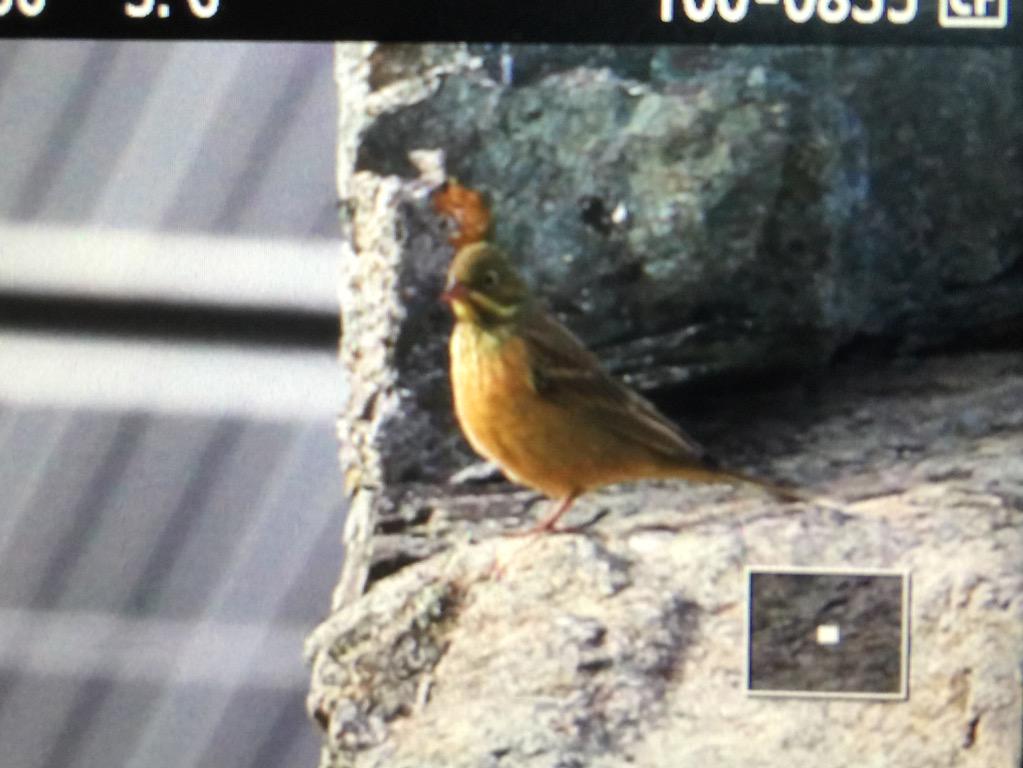
Still, I managed to have a nice little find yesterday afternoon before my departure, in the form of (some!) Ortolan Buntings... I was walking down the mountainside towards Nant in the late afternoon, when a 'glip- glip' call took my attention. Scanning the oat field below me, I immediately picked up on a bunting coming in to land on a wire fence, and after short view my suspicion of Ortolan Bunting was confirmed! It was great to have a back-on view of this first summer individual, although trying to radio everyone else to let them know of this scarcity meant that I didn't get a really good look at it.

After getting people aware of the bird, I tried as best I could to keep my eye on it, but a flighty flock of Linnets made this hard work. After five minutes, the bird took off, and separated away from the Linnets, heading towards the Abbey ruin. I suddenly became aware of a second bird tagging along with it, and it looked identical, apart from different colouration. They both landed on the ruin, and distant views didn't allow much confirmation of my suspicion. But once a Steve joined me from the obs, we walked slowly up the track, and realised that there were indeed two birds!!

The next half hour was frustrating, with the birds becoming increasingly flighty, and not returning to the oat field too often. After twenty minutes, we began to suspect a THIRD bird, and looking back at our record shots of the individuals that had landed, we realised that there were indeed three- two first winters and an adult female!!

Who knows- perhaps we will have a small breeding population of mixed Emberizia buntings next!

Here is an assortment of images from yesterday...

I think the above images just picture two of the birds, but below is a shot by Steve that depicts the third- an adult female perhaps

Tuesday, 8 September 2015

Underwater photography - Lumix FT-5

I have recently acquired a new piece of photographic kit, namely the Lumix FT-5. I bought this compact little camera to try out a bit of underwater photography, admittedly at a fairly low quality, but a progression from GoPro stills from movies nonetheless. Unfortunately the weather has not played ball for the last couple of weeks, meaning murky seas, strong winds, cloudy skies and therefore very little opportunity for taking to the seas. I have managed to get out a few times to try the great little camera out, and I have to say that I am very impressed with its capabilities. The macro is a great function, allowing very close range for small fish and other subjects, whilst the ease of use underwater and quality of images is great. I look forward to using this camera lot more in the coming weeks. Here is a small selection of images for now:

A species of Goby, which I am not entirely sure of yet

Grey Seal encounters! A female above and male (below) came to investigate me whilst I was snorkelling

Two-spotted Gobies (Gobiusculus flavescens)

It was cool to swim amongst this shoal of several hundred White Bait one afternoon- I tried to get below the shoal to get some silhouetted images
a species of Periwinkle I believe